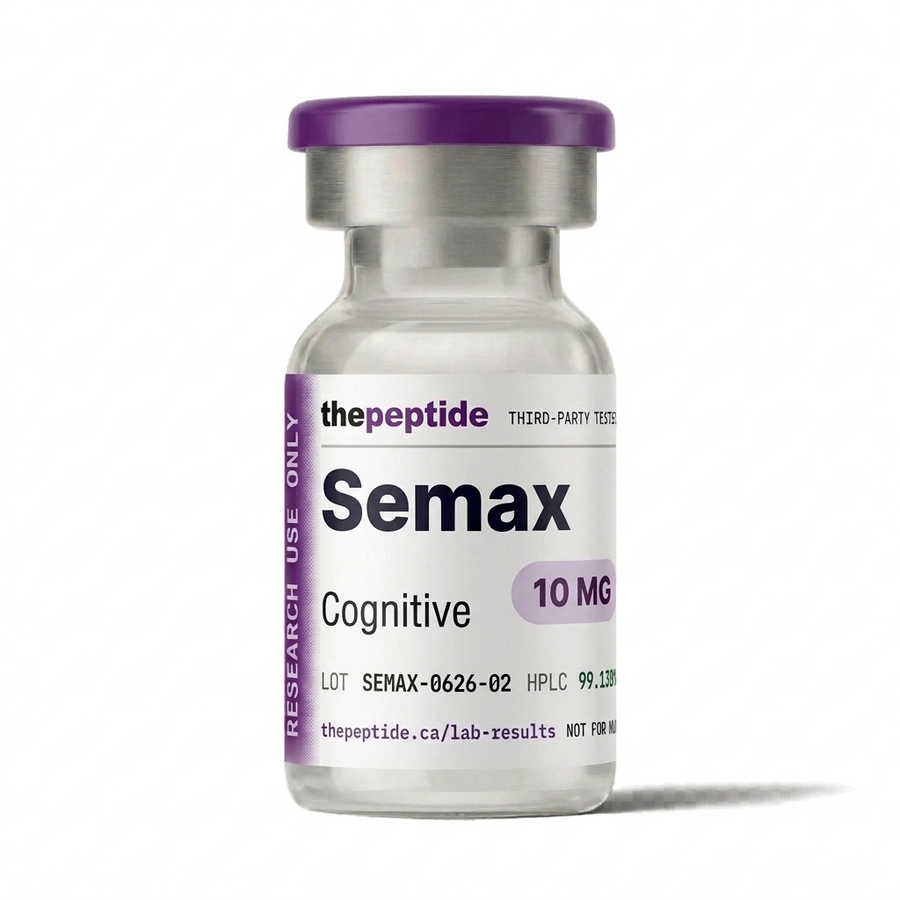
Semax 10mg
ACTH(4-7) Heptapeptide Analogue✓ Third-party tested — lot CS-sem10-0625
Assayed by Janoshik Analytical, report #200391, analysis conducted 13 July 2026: 99.138% purity by reverse-phase HPLC, measured content 11.32 mg against a 10 mg label.
View the batch COA · Testides (Toronto) confirmation pending
Semax is a synthetic heptapeptide derived from the ACTH(4-7) fragment of adrenocorticotropic hormone, supplied here as 10 mg of lyophilised plain (non-acetylated, non-amidated) peptide for laboratory research use only.
The ACTH relationship is worth stating exactly, because most listings state it loosely. Human ACTH(4-10) is Met-Glu-His-Phe-Arg-Trp-Gly; Semax is Met-Glu-His-Phe-Pro-Gly-Pro. It retains ACTH residues 4–7 (Met-Glu-His-Phe) unchanged and replaces Arg⁸-Trp⁹-Gly¹⁰ with a Pro-Gly-Pro tripeptide — the substitution that confers proteolytic stability, since native ACTH(4-10) is rapidly degraded by blood enzymes (Potaman et al., BBRC 1991). Both literature names, ACTH(4-7)PGP and (Pro⁸,Gly⁹,Pro¹⁰)ACTH(4-10), describe the same seven residues; the bare phrase "ACTH(4-10) analogue" hides the mechanistically important part, which is which two residues were discarded.
Semax is a heptapeptide — seven residues, sequence MEHFPGP — formula C₃₇H₅₁N₉O₁₀S, average molecular weight 813.93 g/mol, CAS 80714-61-0, also supplied as the acetate salt. One vial contains 10 mg of white to off-white lyophilised powder, no excipient. A second CAS, 4037-01-8, circulates on vendor pages and Wikipedia as a Semax identifier; it is in fact the CAS for unmodified human ACTH(4-10), a different peptide, and we do not reproduce it.
Three molecules circulate under overlapping names and buyers confuse them constantly. This vial is plain Semax: H-Met-Glu-His-Phe-Pro-Gly-Pro-OH, free acid or acetate salt, MW 813.93, CAS 80714-61-0 — neither acetylated at the N-terminus nor amidated at the C-terminus. N-Acetyl Semax Amidate (NASA, MW 854.98, CAS 2920938-90-3) is a different compound, always sold as its own SKU, and a 10 mg NASA vial holds roughly 5% fewer moles than this one. The terminal modifications are documented as stability changes, not potency changes, and there is no clinical literature on either N-acetylated form — every Russian clinical study used plain Semax.
Read this before anything else written about Semax
Semax has been studied since 1982 and holds an active Russian medicine registration, and that combination lends it clinical authority it has not earned. The evidence base is overwhelmingly Russian-language, concentrated in a handful of Moscow institutions, largely untranslated, and methodologically weak by the standards applied to any modern drug candidate. No large randomised, blinded, placebo-controlled trial exists anywhere; no registered protocols exist for the foundational work; independent Western replication of the clinical findings is essentially absent. That does not make Semax uninteresting as a reagent — it has a demonstrated but unidentified high-affinity binding site in rat brain, and a 2025 Br J Pharmacol paper proposing an entirely new target. It does mean anything framed as "clinically proven" is wrong.
Semax's mechanism of action is unknown. The best-supported observations — BDNF and trkB expression changes in rat brain, increased serotonergic turnover, an anti-inflammatory transcriptome shift in rodent ischemia models — are all rodent or in-vitro, and there is no human receptor occupancy, pharmacokinetic or target-engagement data of any kind. Two claims that dominate vendor copy are contradicted by their own primary sources: Semax did not change dopamine on its own, and it is not established as a melanocortin-receptor agonist.
We supply this material strictly as a reagent for in-vitro and animal-model work, and publish no dosing, route, schedule or protocol information — none has been established by any Western regulator, and the only human dosing that exists sits inside a Russian prescription label for a nasal-drop product we do not sell.
For laboratory and research use only. Not for human consumption, veterinary use, or therapeutic application. Not approved by Health Canada. We do not provide preparation, dilution or administration guidance for any compound we sell.
Read the full research guide →Shipping is free and tracked, Canada-wide, on every order, with no minimum. Orders are dispatched within 48 hours, Monday to Friday, from British Columbia. Estimated delivery: 2–8 business days.
Sealed, unopened vials are exchangeable within 14 days of delivery. Report damage within 48 hours of the expected delivery date.
