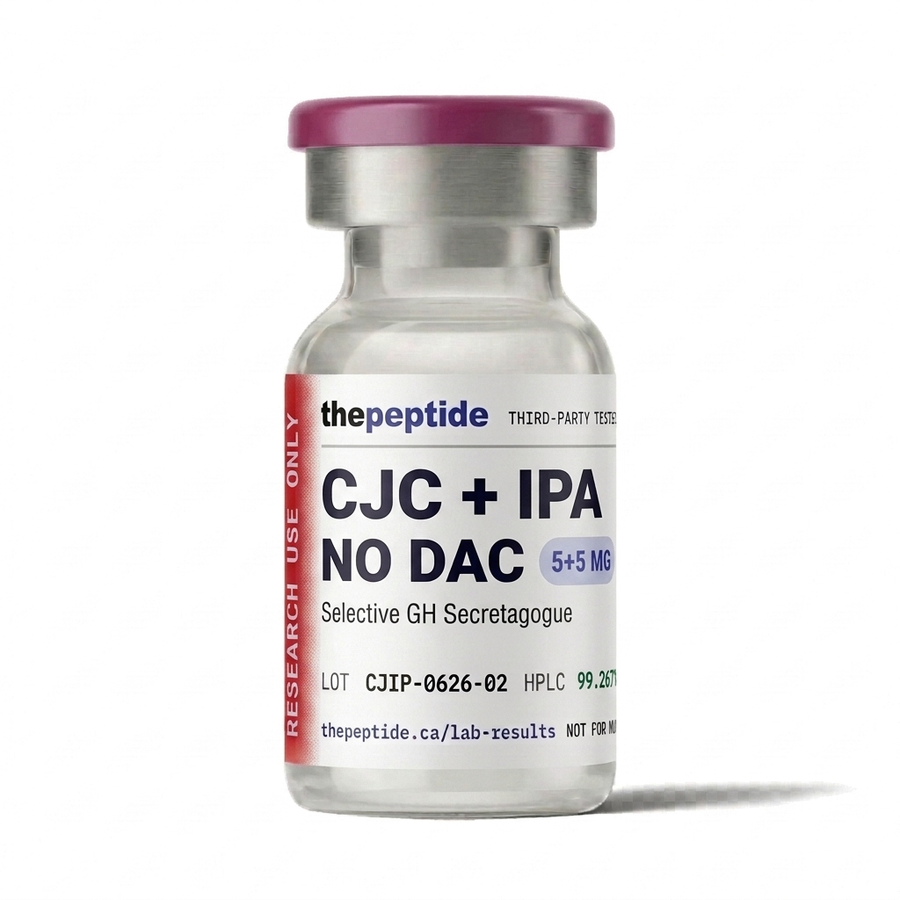
CJC-1295 (no DAC) + Ipamorelin 10mg 10mg (5mg+5mg)
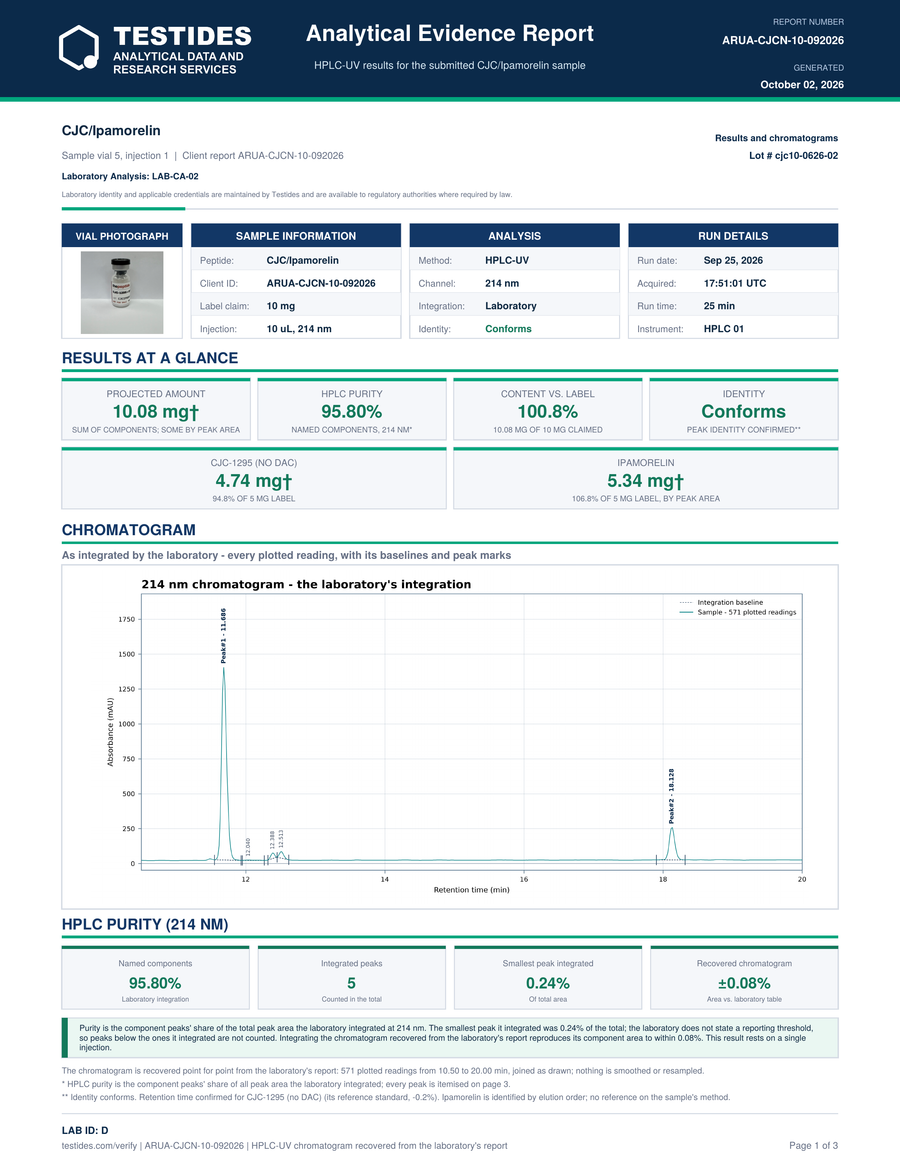
GHRH Analogue + Ghrelin Agonist BlendNamed-component HPLC-UV at 214 nm — CJC-1295 (no DAC) 4.74 mg and Ipamorelin 5.34 mg, 10.08 mg total vs 10 mg label (100.8%). Identity conforms. Enter report ARUA-CJCN-10-092026 at testides.com/verify to see the lab's own record and chromatogram.
✓ Testides-verified — lot cjc10-0626-02
Our confirmatory HPLC-UV is in. Testides, Toronto, report ARUA-CJCN-10-092026, run 25 September 2026 and issued 2 October 2026: 95.80% named-component purity at 214 nm, 10.08 mg total content against a 10 mg label (100.8%), identity Conforms.
On a blend the purity figure that means anything is the combined share of both named components, not a single main peak. Ipamorelin accounts for 81.08% of total integrated area and CJC-1295 (no DAC) for 14.72% — 95.80% together, with the largest single impurity at 2.25%. Component amounts: CJC-1295 (no DAC) 4.74 mg (94.8% of its 5 mg share, read against the laboratory's calibration curve) and ipamorelin 5.34 mg (106.8%, estimated by peak area — the laboratory holds no curve for ipamorelin). Full reasoning below.
Testides verifies this report by the document itself: upload the original PDF at testides.com/verify and it is checked against the laboratory's released copy. Email info@thepeptide.ca and we will send you the PDF · All lab results
This is CJC-1295 without DAC blended with ipamorelin, 5 mg of each in a single 10 mg vial of lyophilised powder — and CJC-1295 without DAC is the same molecule as modified GRF (1-29), not a different compound that shares a name.
That equivalence is the most confused point in this category, so it is worth stating without hedging. CJC-1295 no DAC, mod GRF (1-29) and CJC-1295 DAC-free are three names for one 29-residue peptide: CAS 863288-34-0, formula C152H252N44O42, molecular weight 3367.95 g/mol, C-terminally amidated. Vendors listing them as separate SKUs, or calling one a newer version of the other, are selling the same peptide twice.
Structurally it is sermorelin — native human GRF(1-29)NH₂ — carrying four substitutions: D-Ala², Gln⁸, Ala¹⁵ and Leu²⁷, only one of which has a primary source behind its rationale. The D-Ala² substitution blocks dipeptidyl peptidase-4 cleavage at the Tyr¹-Ala² bond, the dominant plasma inactivation route for GHRH peptides; Jetté et al. (2005) assayed DPP-IV stability directly. The other three are consistent with removing a deamidation liability at Asn⁸ and an oxidation liability at Met²⁷ and with improving potency, but no primary source states each rationale individually.
DAC is a real covalent addition, not a marketing suffix. Drug Affinity Complex is an Nε-maleimidopropionyl group on a lysine appended at position 30; in vivo the maleimide binds Cys34 of serum albumin, tethering the peptide to a long-circulating carrier. The DAC form therefore has 30 residues, CAS 446262-90-4 and a molecular weight of 3647.25 — a mass difference of roughly 280 Da, which is how a buyer tells the two apart on a COA.
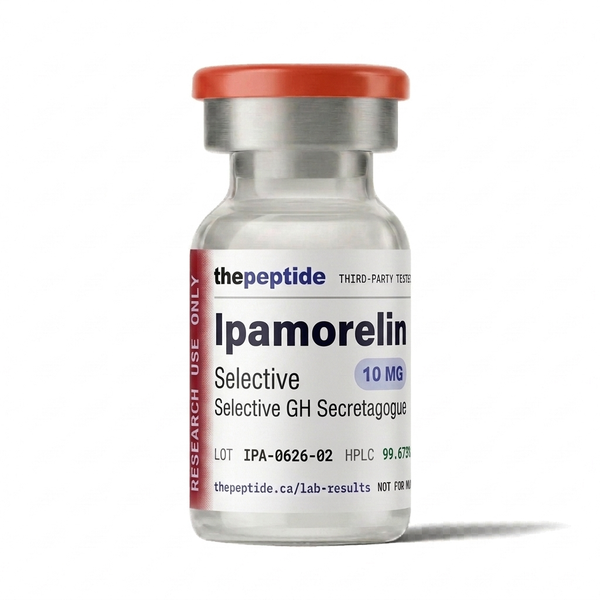
The second component is ipamorelin, development code NNC 26-0161: a pentapeptide, CAS 170851-70-4, formula C38H49N9O5, molecular weight 711.87 g/mol, sequence Aib-His-D-2-Nal-D-Phe-Lys-NH₂ — five residues, two non-proteinogenic (α-aminoisobutyric acid and 2-naphthylalanine) and two D-amino acids.
The two are blended because they act on different receptors through different second messengers on the same pituitary cell: GHRH-R is Gs-coupled through cAMP and PKA, GHS-R1a is Gq-coupled through phospholipase C, IP₃ and calcium. One converging output — a basis for a hypothesis, not evidence of a result.
Read this before any claim you see about CJC-1295 without DAC
Every substantive human and animal study of CJC-1295 used the DAC version — Jetté 2005 (PMID 15817669), Teichman 2006 (PMID 16352683), Alba 2006 (PMID 16822960). There is no published human pharmacokinetic or efficacy trial of the no-DAC molecule at all. The "~30 minute half-life" quoted for it across the industry has no primary human PK study behind it.
The subtler version of the error: a page sells the no-DAC peptide, then cites Teichman's multi-day half-life and sustained GH-elevation figures. Those are DAC figures, following from albumin tethering — the exact feature this molecule lacks. Vendors who cite their sources do this too.
We supply this vial strictly as a laboratory reagent and publish no dosing, route, schedule or protocol information. Neither compound is approved anywhere, and the combination has never been studied in either form.
For laboratory and research use only. Not for human consumption, veterinary use, or therapeutic application. Not approved by Health Canada. We do not provide preparation, dilution or administration guidance for any compound we sell.
Read the full research guide →With DAC: CAS 446262-90-4, MW 3647.25, 30 residues, Nε-maleimidopropionyl-Lys³⁰ binding Cys34 of serum albumin in vivo.
Difference ≈ 280 Da — the figure to look for on a COA.
Shipping is free and tracked, Canada-wide, on every order, with no minimum. Orders are dispatched within 48 hours, Monday to Friday, from British Columbia. Estimated delivery: 2–8 business days.
Sealed, unopened vials are exchangeable within 14 days of delivery. Report damage within 48 hours of the expected delivery date.