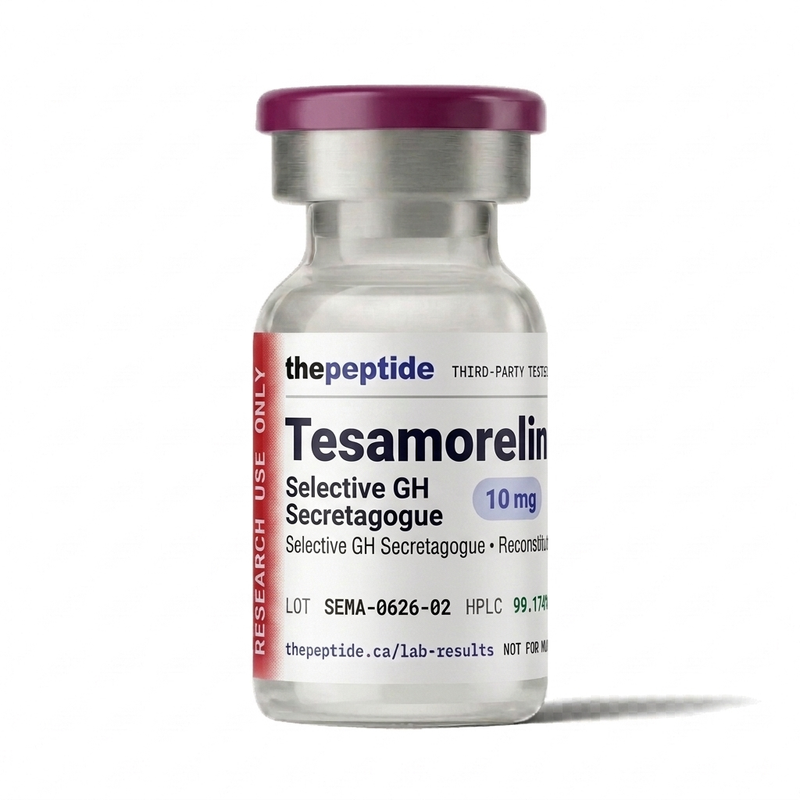
Tesamorelin 10mg
Stabilised GHRH Analogue
This lot was assayed by Janoshik Analytical (report #198440, analysis conducted 1 July 2026) at 99.174% purity, with a measured peptide content of 11.56 mg against a 10 mg nominal fill.
View the batch COA · Testides (Toronto) confirmation pending
Tesamorelin (TH9507) is the complete 44-amino-acid sequence of human growth hormone-releasing hormone carrying a single trans-3-hexenoyl group on its N-terminal tyrosine, supplied here as 10 mg of lyophilised powder for laboratory research.
Structurally it is not a truncated or re-engineered GHRH. It is the full, unaltered hGRF(1-44)NH₂ backbone — YADAIFTNSYRKVLGQLSARKLLQDIMSRQQGESNQERGARARL, C-terminally amidated — with exactly one covalent change: a six-carbon acyl chain bearing a double bond at position 3, amide-linked to the α-amino group of Tyr¹, which is how the FDA prescribing information describes it. The parent molecule is endogenous human GHRH, GRF(1-44)-NH₂ (INN somatorelin). CAS 218949-48-5 (free base), formula C₂₂₁H₃₆₆N₇₂O₆₇S, molecular weight 5135.9 Da; the single sulfur is the methionine at position 27. Each vial contains 10 mg of lyophilised peptide.
The modification addresses a specific liability. The Tyr¹-Ala² dipeptide of native GHRH is the cleavage site for dipeptidyl peptidase-4, the dominant route of GHRH inactivation in plasma, and acylating that terminus sterically obstructs the cleavage. That is the established design rationale and is standard across N-terminally acylated GHRH analogues, but we could not locate an open primary paper measuring tesamorelin's DPP-4 resistance head-to-head against native GHRH, so we present it as rationale rather than as a cited measurement. Affinity is not traded for stability: the label states that in vitro, tesamorelin binds and stimulates human GRF receptors with potency similar to endogenous GRF.
What makes it unusual as a reagent is the depth of its human record — it is the only GHRH analogue with an approved pharmaceutical product, phase III trials, published pharmacokinetics and a full adverse-event table. Read honestly, that record is mixed: the European application was withdrawn before approval, the Canadian listing has been cancelled, a reformulation was rejected once on stability grounds, and the two most recent cognition trials were negative. All of it is below. The vial is supplied strictly as a laboratory reagent; the clinical data exist only because a licensed product was developed from the same molecule under regulatory oversight.
For laboratory and research use only. Not for human consumption, veterinary use, or therapeutic application. Not approved by Health Canada. We do not provide preparation, dilution or administration guidance for any compound we sell.
Key specifications
See product label and the Overview tab.
Specifications
| Compound | Tesamorelin, lyophilised powder |
|---|---|
| Synonyms / development code | TH9507 (TH-9507); trans-3-hexenoyl-hGRF(1-44)-NH₂. Product brands: EGRIFTA, EGRIFTA SV, EGRIFTA WR |
| Compound class | N-terminally acylated GHRH analogue; GHRHR agonist |
| CAS number | 218949-48-5 (free base) |
| Molecular formula | C₂₂₁H₃₆₆N₇₂O₆₇S (free base) |
| Molecular weight | 5135.9 Da (free base) |
| Sequence length | 44 amino acids, C-terminally amidated, plus one N-terminal trans-3-hexenoyl group on Tyr¹ |
| Vial contents | 10 mg lyophilised tesamorelin, sealed vial |
| Current lot | CS-te10-0616 (Janoshik report #198440) |
| Verified purity | 99.174% |
| Measured content | 11.56 mg |
| Test method | HPLC purity and quantitative content; analysis conducted 1 July 2026 |
| Testing laboratory | Janoshik Analytical, independent third party — report #198440. Testides (Toronto) confirmation pending. |
| Storage | Lyophilised: −20 °C long-term, 2–8 °C short-term, desiccated and protected from light |
| Research applications | GHRHR binding and cAMP functional assays; somatotroph culture; GHRHR versus GHS-R1a comparative pharmacology; plasma stability and peptidase work; adipose-depot and hepatic-steatosis models; anti-drug-antibody assay development; LC-MS/MS and RP-HPLC method development |
| Related compounds | Ipamorelin 10mg · CJC-1295 / Ipamorelin |
| Ships from | British Columbia, Canada — free tracked shipping Canada-wide, dispatched within 48 hours |
| Intended use | Laboratory research only — in vitro and preclinical. Not a drug; not for human or veterinary use |
- Sealed vial: −20°C, 24+ months.
- Protect from light and heat.
- Keep in original packaging until use in the laboratory.
How should lyophilised tesamorelin be stored, and does it need refrigeration?
Two answers circulate and contradict each other; both are correct for different materials. The approved pharmaceutical product is a room-temperature product. The FDA label directs storage of the lyophilised EGRIFTA and EGRIFTA SV vial at up to 25 °C, excursions permitted 15–30 °C, protected from light and kept in the original carton. EGRIFTA WR is likewise labelled 20–25 °C before reconstitution. The approved lyophilised drug product does not require refrigeration, which corrects a widespread vendor claim.
Research convention for an unformulated peptide is colder, and the excipient package is why. The drug product is a stabilised formulation with a defined shelf life — mannitol in the 1 mg presentation; mannitol, sucrose, histidine and polysorbate 20 in the 2 mg. Those excipients do real work: bulking and cryoprotection, buffering, and in polysorbate 20’s case a surfactant mitigating interfacial and shear stress on a 44-residue peptide. An unformulated research peptide has none of that and no shelf-life study behind it, which is why the convention for lyophilised GHRH analogues is −20 °C long-term and 2–8 °C short-term, desiccated and dark.
Light protection is label-mandated, not folklore — the instruction to keep the vial in its carton comes from the prescribing information. The structural rationale, two tyrosines plus an oxidation-prone methionine at position 27 and an alkene in the hexenoyl group, is our reading of the structure rather than a cited stability study, and we offer it as rationale only.
Avoid freeze-thaw cycling. Aliquot before freezing so a working stock is never repeatedly thawed, and do not freeze reconstituted material. Reconstituted stability is unusually formulation-dependent here: the older presentations are labelled for immediate use with an explicit instruction not to refrigerate the reconstituted solution, while EGRIFTA WR is labelled for up to 7 days at 20–25 °C — so any blanket claim about how long reconstituted tesamorelin lasts is unsupportable without naming the formulation. We could not verify a published formulation pH or isoelectric point and will not print a number for either.
Finally, stability here is a documented regulator-level weakness rather than a theoretical concern: the FDA’s January 2024 Complete Response Letter cited the stability of both the lyophilised and the reconstituted drug.
How fast do you ship, and is delivery free across Canada?
Shipping is free and tracked, Canada-wide, with no minimum order. Orders are dispatched within 48 hours, Monday to Friday, from our facility in British Columbia. Because the vial is already in Canada there is no international leg, no customs clearance and no brokerage on a domestic order.
Vials ship sealed, with the lot number on the label so it can be matched against the published certificate of analysis. Tracking is issued at dispatch. Current transit estimates are on our shipping page.
What is your refund policy if a vial arrives damaged?
Report damage in transit or non-delivery to info@thepeptide.ca within 48 hours of the expected delivery date, with photographs of the packaging and vial where applicable, and we will resolve it.
Sealed, unopened vials are exchangeable within 14 days of delivery. There are no refunds or exchanges on product that has been opened, reconstituted or otherwise prepared: once a seal is broken we cannot verify handling history, and a reagent of unknown temperature and light exposure is not one we will put back into circulation.
Full terms: refund policy.
How does tesamorelin work at the receptor level, and does it preserve natural GH pulses?
Tesamorelin is an agonist at the growth hormone-releasing hormone receptor (GHRHR), a class-B1 GPCR on pituitary somatotrophs. Occupancy couples through Gs and adenylyl cyclase to raise intracellular cAMP, driving both the synthesis and the release of growth hormone, which drives hepatic IGF-1 production.
Whether pulsatile architecture survives that stimulation was measured, not assumed. Stanley et al. (J Clin Endocrinol Metab 2011;96(1):150-158) ran overnight frequent GH sampling in 13 healthy men after two weeks, measuring mean overnight GH, log₁₀ GH peak area, basal secretion rate, IGF-1 and insulin-stimulated glucose uptake. The pattern reported stayed pulsatile: existing pulses were amplified rather than replaced by a flat elevated plateau.
Because the stimulus is applied upstream at the pituitary, the effect remains subject to somatostatin tone and IGF-1 negative feedback — the brake stays connected and the response is self-limiting. Exogenous recombinant GH, by contrast, abolishes pulsatility and suppresses endogenous secretion. That is why a GHRH analogue is the right probe for physiological axis regulation rather than for GH exposure alone.
Is tesamorelin approved in Canada or the United States?
Health Canada initially refused it. The original New Drug Submission received a Notice of Non-Compliance – Withdrawal over diabetogenic effect and IGF-1-related carcinogenicity concerns. Authorisation followed only after an expert Reconsideration Panel in August 2013: a Notice of Compliance issued 29 April 2014 (NDS 131836, brand EGRIFTA, sponsor Theratechnologies Inc.), with restricted conditions of use including mandatory IGF-1 monitoring, and an indication narrower than the American one.
It was marketed in Canada from 23 June 2015, and has since been withdrawn. Verified against the Health Canada Drug Product Database:
DIN 02438712 — EGRIFTA 1 mg/vial · first marketed 2015-06-23 · Cancelled Post Market, 30 September 2022
DIN 02423677 — EGRIFTA 2 mg/vial · never marketed · Cancelled Pre Market, 13 July 2023
There is no currently marketed tesamorelin product in Canada. EGRIFTA SV and EGRIFTA WR have never been authorised here.
United States. EGRIFTA was approved 27 November 2010, EGRIFTA SV in 2019, and EGRIFTA WR on 25 March 2025, available from 5 September 2025. That approval was not smooth: the FDA issued a Complete Response Letter on 24 January 2024 on chemistry, manufacturing and controls grounds — impurities, microbiological assays, and the stability of both the lyophilised and the reconstituted product — plus a request for more immunogenicity data on the concentrated formulation. Efficacy and bioequivalence were not challenged. A contract-manufacturing shutdown separately caused an EGRIFTA SV shortage from mid-January 2025.
European Union: never approved. Theratechnologies withdrew its marketing authorisation application in June 2012, citing the absence of safety data beyond 48 weeks on elevated IGF-1 and the absence of a cardiovascular endpoint.
Elsewhere: we do not know. We found no evidence either way on the United Kingdom, Australia, Japan or China, and will not call tesamorelin “US-only” on absent evidence. What we can state: approved in the US, approved and no longer marketed in Canada, never approved in the EU.
None of this makes the vial on this page an authorised drug — it is an unapproved research reagent. Tesamorelin is also named explicitly on the WADA Prohibited List under section S2, prohibited at all times.
Tesamorelin vs ipamorelin — which limb of the GH axis does each one probe?
“Which is better” is the wrong question. These compounds act on different receptors, through different second messengers, on the same cell — which is why co-administration studies of the two classes exist at all.
Tesamorelin — GHRH analogue
GHRHR, Gs/cAMP. Drives GH synthesis and release, and sets pulse amplitude. Opposed by hypothalamic somatostatin, so endogenous negative feedback stays intact and caps the response. Pulsatility amplified and preserved (measured, Stanley 2011). Regulatory-grade human record: phase III RCTs, an approved product, published PK.
Ipamorelin — GHS-R1a agonist
GHS-R1a, the ghrelin receptor, Gq/PLC/IP₃-Ca²⁺. Triggers release of already-made GH and functionally antagonises somatostatin tone rather than working against it. Different ceiling behaviour, classically synergistic with a GHRH analogue. No approved product and no phase III human efficacy data.
Three design consequences. Comparator choice: work isolating GHRH-pathway signalling cannot use a ghrelin mimetic as its comparator, or vice versa — they are two arms of a synergy model, not substitutes. Confound profile: GHS-R1a is also the orexigenic receptor and is expressed outside the pituitary, so ghrelin-receptor agonists carry food-intake and GI-motility confounds a GHRHR agonist does not. Evidence asymmetry: tesamorelin is the only compound in this class with regulatory-grade human characterisation. If a GHS-R1a probe is what the protocol needs, tesamorelin is the wrong reagent — see Ipamorelin 10mg.
What has been published on tesamorelin, and what are the limits?
Not a weight-loss agent. The FDA label carries an explicit Limitation of Use: not indicated for weight loss management. Makimura 2012, the main non-HIV randomised trial, found no significant weight change over 12 months (P = 0.52) despite a measured visceral fat effect in the same study; Clemmons 2017 found no change in weight, BMI, body fat or waist circumference over 12 weeks, and no change in glycaemic control. The effect is compartment redistribution, not mass reduction.
No cardiovascular outcome benefit demonstrated. “Long-term cardiovascular safety and benefit have not been studied” is a label Limitation of Use, and the missing cardiovascular endpoint was a stated reason for the 2012 EU withdrawal. The carotid intima-media thickness change reported in Makimura 2012 is a surrogate, not an outcome.
Cognition is not established, and the two most recent trials are negative. Baker et al. (Arch Neurol 2012) is the positive signal everyone cites: 137 completers aged 55-87, 20 weeks, measuring cognitive test performance and IGF-1 in healthy and mild-cognitive-impairment groups, with the authors themselves calling for larger trials. Those have partly happened and have not replicated it. Ellis et al. (J Infect Dis 2025) randomised 73 people with HIV and abdominal obesity over six months and missed the primary endpoint — between-group P = 0.673 — concluding no clear benefit. Stewart et al. (eNeurologicalSci 2026), a 22-participant double-blind low-dose pilot, reported that treatment “was not directly linked with significant changes in study measures”.
Liver histology is unproven. The 12-month Lancet HIV 2019 trial measured hepatic fat fraction by imaging; its authors conclude only that tesamorelin “might be beneficial” and that further studies are needed on liver histology. NASH resolution and fibrosis outcomes are not established. A general-population NASH programme was announced in September 2020; we found no published results and no discontinuation notice, and claim neither.
Population limits. Almost all human efficacy data come from people with HIV and lipodystrophy; Makimura 2012 is the main exception, and there are no paediatric data. A 2026 meta-analysis of tesamorelin RCTs exists (PMID 41545261); we have not verified its pooled estimates and quote no numbers from it.
What happens when tesamorelin is discontinued?
The visceral fat comes back, and this is measured rather than inferred. Falutz et al. (AIDS 2008;22(14):1719-1728) re-randomised 410 participants at week 26. Those continuing on tesamorelin sustained the visceral adipose tissue change over 52 weeks; those switched to placebo reaccumulated VAT across weeks 26 to 52. The authors conclude that the effects do not last beyond the duration of treatment.
No published evidence shows a durable post-treatment benefit, and the mechanism makes that unsurprising: a secretagogue acting on an intact, feedback-regulated axis leaves little trace once the stimulus is removed. Labelled fluid-retention effects conversely tend to resolve after stopping. Any protocol asking about persistence therefore needs an off-treatment arm.
Why do about half of treated subjects develop anti-tesamorelin antibodies?
In the clinical record documented in the FDA label, 49.5% of treated patients developed anti-tesamorelin IgG antibodies by 26 weeks and 47.4% by 52 weeks, with cross-reactivity to endogenous GHRH in roughly 60% of antibody-positive patients. Antibody presence did not reduce the visceral fat or IGF-1 response. Of patients with hypersensitivity reactions, 85.2% were antibody-positive; labelled hypersensitivity reactions occurred in 3.6% overall.
Why that is interesting rather than merely a safety line: tesamorelin is a self-sequence peptide with one small non-native acyl modification, and it still elicits antibodies in about half of exposed subjects, much of it cross-reactive with the endogenous hormone — a well-quantified natural experiment in tolerance and epitope formation.
That makes it a substantive model antigen for anti-drug-antibody assay development, analogue-versus-parent cross-reactivity, and epitope-mapping method work. It is also why the FDA requested more immunogenicity data when reviewing the concentrated formulation in 2024.
What purity is this lot, and how do I read the COA?
Lot CS-te10-0616 was submitted to Janoshik Analytical, an independent third-party laboratory, and reported under report #198440, analysis conducted 1 July 2026: purity 99.174%, measured peptide content 11.56 mg against a 10 mg nominal fill. This is the Janoshik Analytical assay; Testides (Toronto) confirmation is still pending. Every current lot is indexed on our lab results page.
Those two figures do different jobs, and conflating them is the commonest error in reading a COA. Purity is the proportion of peptide-containing material that is the target peptide, as resolved by HPLC; it says nothing about how much is in the vial. Content is the quantitative mass determination; it says nothing about what the remainder is. A vial can be 99% pure and underfilled, or correctly filled and 90% pure — you need both, from the same lot, with the lot number matching the vial label. Full walkthrough: how to read a peptide COA.
One caveat almost no supplier mentions: the pharmaceutical drug substance is the acetate salt, the label formula being the free base plus roughly seven acetic acid equivalents — around 8% heavier. We do not print an acetate CAS number or acetate molecular weight as established, because the figures circulating online rest on a single secondary source and on arithmetic estimation rather than a primary measurement. Either way, a vial characterised by peptide content and one characterised by total salt mass are not the same quantity.
What is the half-life of tesamorelin?
The two label generations disagree, so we show both rather than pick one. The EGRIFTA prescribing information, section 12.3, reports a terminal half-life after 14 days of subcutaneous administration of 26 minutes in healthy subjects and 38 minutes in HIV-infected patients. The later EGRIFTA SV / EGRIFTA WR label states 8 minutes in healthy subjects. Both are label-sourced, and volume of distribution likewise differs across label versions (9.4–10.5 L/kg versus 4.8 L/kg). The widely copied “26 to 38 minutes” is one of these figures reproduced without the label version, formulation or route it belongs to.
Worth pairing with it: subcutaneous bioavailability is documented at under 4%. That is genuinely unusual, and it is why exposure and effect decouple so sharply here — a short plasma residence with very low systemic availability still produces sustained IGF-1 elevation, because the readout is a downstream secretory cascade rather than the peptide itself.
Is tesamorelin the same compound as adipotide?
No. The synonym list attached to CAS 218949-48-5 in at least one widely scraped chemical database carries contaminated entries, including “Adipotide/FTTP”. Adipotide is an unrelated prohibitin-targeting peptidomimetic with a different structure, target and mechanism, so any listing reproducing a scraped synonym block publishes a false synonym. Two neighbouring corrections while we are here: tesamorelin is not sermorelin, which is the shorter GHRH(1-29)NH₂ fragment rather than tesamorelin’s parent; and EGRIFTA is not a different molecule, but the brand name of the product formulated from tesamorelin acetate.
What are the key published studies on tesamorelin?
Falutz J, et al. N Engl J Med. 2007;357(23):2359-2370 — pivotal 26-week phase III, placebo-controlled; measured visceral adipose tissue and IGF-1.
Falutz J, et al. AIDS. 2008;22(14):1719-1728 — 410 patients re-randomised at week 26: continued treatment sustained the VAT change; on discontinuation VAT reaccumulated.
Falutz J, et al. J Clin Endocrinol Metab. 2010;95(9):4291-4304 — pooled phase 3 dataset behind the label safety table; VAT measured at 26 and 52 weeks.
Stanley TL, et al. J Clin Endocrinol Metab. 2011;96(1):150-158 — the pulsatility paper: GH pulse amplitude and mean overnight GH increased with the pulsatile pattern preserved.
Makimura H, et al. J Clin Endocrinol Metab. 2012;97(12):4769-4779 — main non-HIV RCT, 12 months: measured VAT, with no significant weight change (P=0.52).
Baker LD, et al. Arch Neurol. 2012;69(11):1420-1429 — the positive cognition signal: 137 completers, 20 weeks, favourable effect in healthy and MCI groups; authors called for larger trials.
Stanley TL, et al. Lancet HIV. 2019;6(12):e821-e830 — 12-month NAFLD trial: measured hepatic fat fraction by imaging; histology left undetermined.
Ellis RJ, et al. J Infect Dis. 2025;231(5):1230-1238 — negative: open-label phase 2, n=73, six months, between-group P=0.673 on the primary endpoint.
Mix any research peptides 10 mg or larger — the discount counts your whole order, not one product.
YOU MAY ALSO LIKE
SHOP ALL
Frequently Bought Together
Laboratory supplies commonly ordered alongside research compounds.
Bacteriostatic Water 10mL — Sterile Multi-Use Laboratory Water with 0.9% Benzyl Alcohol
Sterile Preserved Laboratory Water
STARTING AT ▸ $22.00