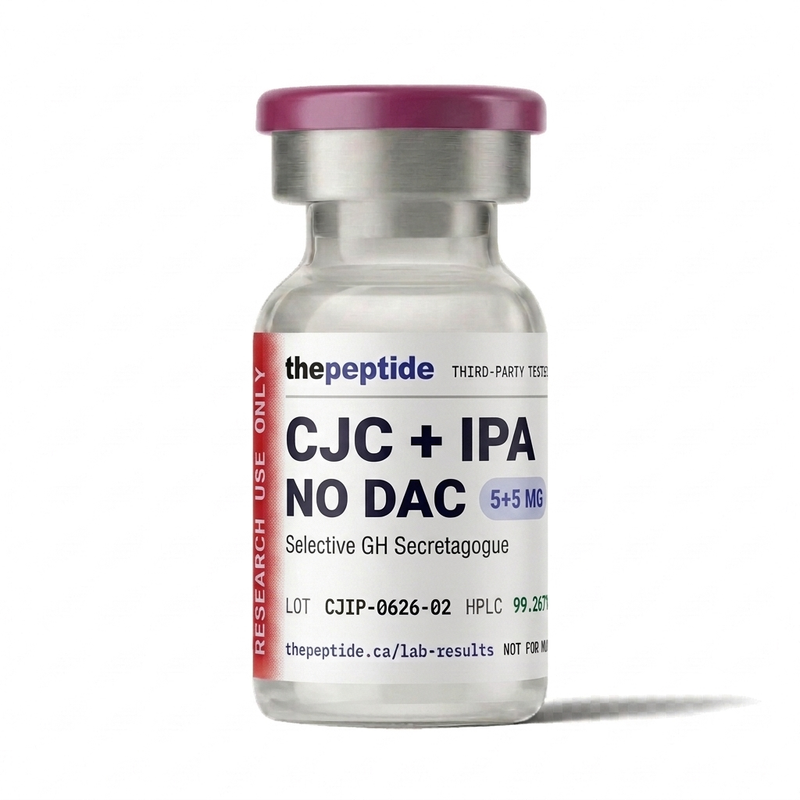
CJC-1295 (no DAC) + Ipamorelin 10mg
GHRH Analogue + Ghrelin Agonist Blend
✓ Third-party tested — identity and content confirmed
The finished blend was assayed by Janoshik Analytical, report #209639, July 2026. Both APIs were identified and quantified: ipamorelin 5.96 mg and CJC-1295 (modified GRF 1-29) 5.07 mg.
Purity is not assayed on blends, and we publish no purity figure for this product. Area-percent purity presupposes a single target peptide; a two-API vial has two main peaks, both of which are product. Identity and ratio confirmation is the assay that means something on a finished blend, and that is what #209639 provides — full reasoning below. Testides confirmation is pending, as it is for our other Janoshik-tested lots.
This is CJC-1295 without DAC blended with ipamorelin, 5 mg of each in a single 10 mg vial of lyophilised powder — and CJC-1295 without DAC is the same molecule as modified GRF (1-29), not a different compound that shares a name.
That equivalence is the most confused point in this category, so it is worth stating without hedging. CJC-1295 no DAC, mod GRF (1-29) and CJC-1295 DAC-free are three names for one 29-residue peptide: CAS 863288-34-0, formula C152H252N44O42, molecular weight 3367.95 g/mol, C-terminally amidated. Vendors listing them as separate SKUs, or calling one a newer version of the other, are selling the same peptide twice.
Structurally it is sermorelin — native human GRF(1-29)NH₂ — carrying four substitutions: D-Ala², Gln⁸, Ala¹⁵ and Leu²⁷, only one of which has a primary source behind its rationale. The D-Ala² substitution blocks dipeptidyl peptidase-4 cleavage at the Tyr¹-Ala² bond, the dominant plasma inactivation route for GHRH peptides; Jetté et al. (2005) assayed DPP-IV stability directly. The other three are consistent with removing a deamidation liability at Asn⁸ and an oxidation liability at Met²⁷ and with improving potency, but no primary source states each rationale individually.
DAC is a real covalent addition, not a marketing suffix. Drug Affinity Complex is an Nε-maleimidopropionyl group on a lysine appended at position 30; in vivo the maleimide binds Cys34 of serum albumin, tethering the peptide to a long-circulating carrier. The DAC form therefore has 30 residues, CAS 446262-90-4 and a molecular weight of 3647.25 — a mass difference of roughly 280 Da, which is how a buyer tells the two apart on a COA.
The second component is ipamorelin, development code NNC 26-0161: a pentapeptide, CAS 170851-70-4, formula C38H49N9O5, molecular weight 711.87 g/mol, sequence Aib-His-D-2-Nal-D-Phe-Lys-NH₂ — five residues, two non-proteinogenic (α-aminoisobutyric acid and 2-naphthylalanine) and two D-amino acids.
The two are blended because they act on different receptors through different second messengers on the same pituitary cell: GHRH-R is Gs-coupled through cAMP and PKA, GHS-R1a is Gq-coupled through phospholipase C, IP₃ and calcium. One converging output — a basis for a hypothesis, not evidence of a result.
Read this before any claim you see about CJC-1295 without DAC
Every substantive human and animal study of CJC-1295 used the DAC version — Jetté 2005 (PMID 15817669), Teichman 2006 (PMID 16352683), Alba 2006 (PMID 16822960). There is no published human pharmacokinetic or efficacy trial of the no-DAC molecule at all. The "~30 minute half-life" quoted for it across the industry has no primary human PK study behind it.
The subtler version of the error: a page sells the no-DAC peptide, then cites Teichman's multi-day half-life and sustained GH-elevation figures. Those are DAC figures, following from albumin tethering — the exact feature this molecule lacks. Vendors who cite their sources do this too.
We supply this vial strictly as a laboratory reagent and publish no dosing, route, schedule or protocol information. Neither compound is approved anywhere, and the combination has never been studied in either form.
For laboratory and research use only. Not for human consumption, veterinary use, or therapeutic application. Not approved by Health Canada. We do not provide preparation, dilution or administration guidance for any compound we sell.
- CJC-1295: 5 mg + Ipamorelin: 5 mg
- Total: 10 mg pre-blended
- Class: GHRH analogue + GH secretagogue
- Purity: ≥99% (HPLC)
Specifications
| Product | CJC-1295 (no DAC) + Ipamorelin blend, 10 mg total, lyophilised powder |
|---|---|
| Vial contents | 5 mg CJC-1295 without DAC + 5 mg ipamorelin, blended 1:1 by mass |
| Component 1 — names | CJC-1295 without DAC = modified GRF (1-29) = CJC-1295 DAC-free. One molecule |
| Component 1 — CAS | 863288-34-0 |
| Component 1 — formula / MW | C152H252N44O42, 3367.95 g/mol |
| Component 1 — sequence | 29 residues, C-terminally amidated. Sermorelin with four substitutions: D-Ala², Gln⁸, Ala¹⁵, Leu²⁷ |
| Component 2 — names | Ipamorelin; development code NNC 26-0161 |
| Component 2 — CAS | 170851-70-4 |
| Component 2 — formula / MW | C38H49N9O5, 711.87 g/mol |
| Component 2 — sequence | 5 residues, C-terminally amidated — Aib-His-D-2-Nal-D-Phe-Lys-NH₂. Two non-proteinogenic residues (Aib, 2-naphthylalanine) and two D-amino acids |
| DAC vs no-DAC — the check |
No DAC (this product): CAS 863288-34-0, MW 3367.95, 29 residues. With DAC: CAS 446262-90-4, MW 3647.25, 30 residues, Nε-maleimidopropionyl-Lys³⁰ binding Cys34 of serum albumin in vivo. Difference ≈ 280 Da — the figure to look for on a COA. |
| Compound classes | GHRH-R agonist (Gs–cAMP–PKA) blended with a GHS-R1a agonist (Gq–PLC–IP₃–Ca²⁺) |
| Assay status | Identity and content confirmed — ipamorelin 5.96 mg, CJC-1295 (mod GRF 1-29) 5.07 mg |
| Purity | Not assayed on blends; no figure published for this product. Area-percent purity is defined against a single target peak; a two-API vial has two, both of which are product |
| Testing laboratory | Janoshik Analytical, independent third party. Report #209639, July 2026, indexed on our lab results page |
| Pending | Testides confirmation pending, as for our other Janoshik-tested lots. We claim no accreditation or ISO status |
| Storage | Lyophilised: −20 °C long-term, 2–8 °C short-term, sealed, desiccated, dark |
| Research applications | Dual-receptor somatotroph pharmacology (GHRH-R versus GHS-R1a); cAMP and calcium-flux assays; pathway-convergence models; DPP-4 and plasma-peptidase stability work; GHS-R1a selectivity screening; two-analyte LC-MS/MS method development; DAC versus no-DAC identity discrimination |
| Related compounds | Ipamorelin 10mg · Tesamorelin 10mg |
| Ships from | British Columbia, Canada. Free tracked shipping Canada-wide, no minimum order, dispatched within 48 hours Monday to Friday |
| Intended use | Laboratory research only, in vitro and preclinical. Not a drug; not for human or veterinary use |
Lab Results
- Sealed vial: −20°C, 24+ months.
- Protect from light and heat.
- Keep in original packaging until use in the laboratory.
How should the lyophilised blend be stored and handled in the laboratory?
Bench handling only; no dosing, route or schedule guidance is given or implied. Note that D-Ala² blocking DPP-4 cleavage is a claim about proteolytic stability in a biological matrix, not shelf stability — the two are routinely confused.
Lyophilised material. The convention for peptides of this class is −20 °C long-term and 2–8 °C short-term, sealed, desiccated and protected from light, with −80 °C for archival material. Lyophilised peptides are hygroscopic, so keep the vial sealed and let it equilibrate to room temperature before opening. We have no published stability-indicating study for this blend and quote no shelf-life figure.
A blend carries a handling consideration a single peptide does not. Two peptides of very different mass share one vial, so withdrawing from an incompletely dissolved vial risks a ratio that does not match the label. Dissolve fully and confirm it visually first; otherwise the measured 5.96 mg / 5.07 mg figures say nothing about what ends up in the aliquot.
Reconstitution conventions. Add diluent slowly down the vial wall and swirl or roll gently; never shake or vortex, since agitation generates air–liquid interface and shear stress, both of which promote aggregation. Prepare single-use aliquots and avoid freeze–thaw cycling. We publish no reconstituted-stability window, because no forced-degradation study exists for this blend. Move the vial to −20 °C on arrival; the powder tolerates ambient temperature through domestic transit.
How fast do you ship, and is delivery free across Canada?
Shipping is free and tracked, Canada-wide, with no minimum order. Orders are dispatched within 48 hours, Monday to Friday, from our facility in British Columbia. Because the vial is already in Canada there is no customs clearance and no brokerage on a domestic order.
A tracking number is emailed as soon as the label is generated. Vials are packed dry and sealed in discreet outer packaging, with the lot number on the label for matching against the published report.
Current transit estimates by province and current dispatch status: shipping information.
What is your refund policy if a vial arrives damaged?
Report transit damage or non-delivery to info@thepeptide.ca within 48 hours of the expected delivery date, with your order number and photographs of the packaging and vial. Confirmed damage and non-delivery are resolved by replacement or refund.
Sealed, unopened vials in original condition are exchangeable within 14 days of delivery. We cannot accept anything back that has been opened, punctured or reconstituted: once a seal is broken we cannot verify chain of custody, and a reagent of unknown storage exposure is not one we will put back into circulation.
Governing terms, including how money is refunded and to which payment method: refund policy.
Is CJC-1295 without DAC the same molecule as modified GRF (1-29), and how do I confirm which one I have?
Yes — identical. Both names denote the same 29-residue peptide: CAS 863288-34-0, C152H252N44O42, 3367.95 g/mol, C-terminally amidated. The split is historical, not chemical: ConjuChem attached the CJC-1295 name to the DAC-bearing analogue, and when the DAC-free backbone began circulating separately it kept that name in some places and acquired the descriptive "modified GRF (1-29)" in others.
The COA check is one number. Expect approximately 3367.95 for the no-DAC molecule and approximately 3647.25 with DAC — a gap no degradation product or salt form closes. Read the mass on the report, not the name on the label.
What to check, in order
1. Reported mass or CAS — 3367.95 / 863288-34-0 for no DAC, 3647.25 / 446262-90-4 for DAC. 2. Residue count if stated: 29 versus 30. 3. Whether the report is tied to the lot on your vial — a report number that matches nothing on the label describes some other material. 4. On a blend, whether both analytes appear; a report naming one API says nothing about the other.
Albumin tethering is the entire point of DAC and the source of the multi-day figures in the published trials, so the two forms behave nothing alike. Full walkthrough: how to read a peptide COA.
What does each compound do at the receptor, and why are the two blended?
Two receptors, two second-messenger systems, one target cell — sound reasoning, which is a different thing from a demonstrated result.
CJC-1295 no DAC / mod GRF (1-29) — GHRH-R
Agonist at the GHRH receptor, a class-B1 GPCR on pituitary somatotrophs, coupling through Gs → adenylyl cyclase → cAMP → PKA. The consequential detail is that this pathway does two jobs: it releases stored GH and drives transcription of the GH gene. Applied upstream, so somatostatin tone and IGF-1 feedback stay in circuit.
Ipamorelin — GHS-R1a
Agonist at the ghrelin receptor, coupling through Gq → phospholipase C → IP₃ → intracellular Ca²⁺, acting on release of already-synthesised hormone rather than synthesis. Its distinguishing published property is selectivity: Raun 1998 reported GH release comparable to GHRP-6 in rats and swine without raising ACTH or cortisol even at 200× the GH-releasing threshold.
Why combine rather than double one: two agonists at one receptor compete for the same sites and saturate the same transducer, so the second buys progressively less, whereas two agonists at different receptors recruit independent machinery converging on one secretory apparatus — the precondition for a more-than-additive response, which still has to be measured. These are two arms of a convergence model, not interchangeable probes, so neither can serve as the other's comparator; where a single-receptor probe is needed, use Ipamorelin 10mg or Tesamorelin 10mg.
Is GHRH-analogue plus ghrelin-agonist synergy actually established?
As a class effect in humans, yes. For this specific pair, no.
The class-level finding is solid: Veldhuis and Bowers (2009, PMID 19240251) studied 47 men and treated GHRH–GHRP synergy as a measurable quantity, rather than merely observing that co-administration produced more GH than either agent alone.
No published study exists of CJC-1295 combined with ipamorelin — in either the DAC or the no-DAC form. Not a trial, not a pharmacokinetic study, not a dose-finding study. The rationale for this blend transfers from data generated with different GHRH analogues and different secretagogues, principally GHRP-2. That transfer is how mechanistic class reasoning normally works; it is not a result, and presenting it as one substitutes an inference for an experiment.
Two reasons the transfer is not automatic. Ipamorelin's defining property is its selectivity relative to GHRP-6, the compound anchoring much of the synergy literature; and an interaction between two stimuli depends on their temporal overlap, so a synergy quantified with one pairing carries no numerical estimate to another. The mechanism is real, human data support the interaction as a class phenomenon, and this combination has never been tested.
Why is there no purity percentage on a blended vial?
Because the number would be meaningless, and producing one would require misrepresenting half the product as an impurity. HPLC purity is an area-percent measurement, main-peak area over total peak area, and that definition assumes there is a main peak, singular, with everything else being truncations, deletion sequences or degradation products.
A 1:1 blend breaks that assumption definitionally. This vial produces two large, well-separated peaks, roughly 3368 Da and roughly 712 Da, both of them product. The single number the assay is built to produce is undefined: to report one, a laboratory would have to nominate one API as the target and count the other as an impurity, returning something near 50% — arithmetically correct, completely false as a quality statement.
Which is why a purity percentage on a blended peptide product is a red flag rather than a reassurance: a vendor quoting 99% on a two-API vial is either presenting a raw-material assay as the finished blend, or quoting a number no laboratory produced.
What is meaningful on a finished blend is identity and ratio. Are both declared peptides present? Is each the right molecule, mod GRF (1-29) at 3367.95 rather than the DAC form at 3647.25? Is the ratio what the label claims?
Janoshik report #209639, July 2026, answers exactly those questions: both APIs identified, ipamorelin 5.96 mg and CJC-1295 (mod GRF 1-29) 5.07 mg against a nominal 5 mg + 5 mg fill. Testides confirmation is pending, and we will publish it when it exists rather than describing it in advance. We publish no purity figure and claim no accreditation. Every lot we have tested is indexed on the lab results page.
What does the published evidence not support, and how did both development programmes end?
1. No human pharmacokinetic or efficacy trial of CJC-1295 without DAC exists. Jetté 2005, Teichman 2006 and Alba 2006 all used the DAC version, so the no-DAC molecule is uncharacterised in humans. The "~30 minute half-life" appears on nearly every page selling this peptide, usually uncited; inferring it from D-Ala²-conferred DPP-4 resistance is a plausible expectation, not a measurement, so we quote no half-life. Teichman's multi-day half-life and sustained GH-elevation findings exist because DAC tethers the peptide to albumin.
2. The blend itself has never been studied in either CJC-1295 form.
3. Ipamorelin's only human efficacy trial missed its primary endpoint. Beck et al. (2014, PMID 25331030), phase 2 randomised, double-blind, placebo-controlled, 114 participants with postoperative ileus: 25.3 hours versus 32.6 hours, p = 0.15. Development stopped afterwards. It is a real, appropriately blinded trial, and it is negative. The preclinical record stands separately: Raun et al. (1998, PMID 9849822) established selectivity in rats and swine, which is animal pharmacology, not human efficacy.
4. The CJC-1295 programme ended in 2006. ConjuChem took CJC-1295 with DAC into phase II for HIV-associated lipodystrophy; on 17 July 2006 the 192-participant study was halted after a participant at an Argentine site died following his eleventh injection.
Established: the death occurred; the study was halted on 17 July 2006; the attending physician concluded the death was not related to the study drug; the programme was terminated as a precaution. CJC-1295 was never revived and has never been approved anywhere.
Not established, in either direction: no published follow-up establishes causation. We do not imply the drug caused the death, and we do not present it as cleared.
None of this makes the material uninteresting as a reagent — an unresolved mechanism with a well-defined two-receptor structure is what preclinical work is for. It does mean anything framed as "clinically proven" or "demonstrated synergy" asserts what the literature does not contain.
Do growth hormone secretagogues suppress somatostatin?
No — the primary literature says close to the opposite. "The GHRP suppresses somatostatin, which is why the combination works" appears on a large share of pages selling this blend, and it inverts the actual finding.
Tannenbaum and Bowers (2001) establish three things. GHS action is GHRH-dependent — anti-GHRH serum abolishes the GHRP-6 response. Growth hormone secretagogues do not suppress somatostatin. And somatostatin still blunts the GHS response at trough times, which it could not do if the secretagogue were switching somatostatin off.
The GHRH-dependence finding matters more than the correction itself, because it reframes what a blend is doing. If the secretagogue's effect requires GHRH tone, pairing it with a GHRH-receptor agonist is not "releasing a brake and pressing an accelerator" — it is supplying the permissive signal the secretagogue needs alongside that compound's own Gq-mediated stimulus, which predicts an interaction dependent on the timing of endogenous somatostatin tone.
Two related claims we decline to make: ipamorelin is not a somatostatin inhibitor, and the blend does not produce a response unconstrained by feedback. IGF-1 negative feedback and somatostatin tone both remain in circuit, because both compounds act on the pituitary rather than replacing its output.
What is the regulatory position in Canada, at FDA, and under the WADA Prohibited List?
Health Canada has named both of these compounds. A public advisory dated 9 April 2026 on injectable peptides bought online names both CJC-1295 and ipamorelin, states that peptides of this kind are generally regulated as prescription drugs in Canada, and says explicitly that "research use only" labelling does not make these products legal or exempt from regulatory requirements.
We publish that knowing it cuts against our own interest, because the alternative is pretending a disclaimer is a legal shield after the regulator has said it is not. Our research framing therefore has to be real rather than decorative: we supply this vial as a reagent, publish no dosing or protocol information, and make no human-use claims. Whether a particular purchase or use is lawful in your circumstances is a question for a Canadian regulatory lawyer, not a product page.
FDA's position on compounded CJC-1295 is worth quoting directly: "may pose risk for immunogenicity for certain routes of administration and may have complexities with regard to ... peptide-related impurities and API characterization. FDA has identified serious adverse events associated with CJC-1295 including increased heart rate and systemic vasodilatory reaction." Two of those concerns, impurity profiling and API characterisation, are analytical rather than clinical, which is why lot-specific third-party testing is the minimum standard here.
WADA: both are prohibited at all times, and both are non-Specified, under S2.2.4 — CJC-1295 under "GHRH and its analogues", alongside CJC-1293, sermorelin and tesamorelin; ipamorelin under "growth hormone secretagogues and their mimetics". One detail catches people out: the List names "CJC-1295" with no DAC qualifier, so both forms are covered. Athletes in tested sport should obtain a written determination from their national anti-doping organisation rather than rely on any vendor's reading.
Approval status: CJC-1295 has never been approved by any regulator anywhere, in either form, and ipamorelin has no approved product. The vial on this page is an unapproved research reagent, and none of the above is legal advice.
Which published studies matter here, and what did each one measure?
Note the pattern: every CJC-1295 entry used the DAC version, and no entry studied the two in combination.
Raun K, et al. Eur J Endocrinol. 1998. PMID 9849822 — the foundational ipamorelin paper. Rats and swine; GH release comparable to GHRP-6, no elevation of ACTH or cortisol even at 200× the GH-releasing threshold. Frequently miscited as PMID 9893259; that is not this paper.
Jetté L, et al. 2005. PMID 15817669 — CJC-1295 with DAC. Source for the DPP-IV stability assessment behind D-Ala², and the albumin-binding design.
Teichman SL, et al. 2006. PMID 16352683 — CJC-1295 with DAC. Half-life 5.8–8.1 days; GH elevation measured over at least six days. The most-misapplied figures in this category: they describe the albumin-tethered molecule. Frequently miscited as PMID 16384846; that is not this paper.
Alba M, et al. 2006. PMID 16822960 — CJC-1295 with DAC. Again, not the no-DAC molecule.
Tannenbaum GS, Bowers CY. 2001 — the somatostatin correction: GHS action is GHRH-dependent, secretagogues do not suppress somatostatin, and somatostatin still blunts the response at trough.
Veldhuis JD, Bowers CY. 2009. PMID 19240251 — human, n = 47 men. Treats GHRH–GHRP synergy as a measurable quantity; the strongest support for the class-level blending rationale, with a different secretagogue and GHRH analogue from the two in this vial.
Beck DE, et al. 2014. PMID 25331030 — human; phase 2, randomised, double-blind, placebo-controlled, n = 114, postoperative ileus. Primary endpoint missed: 25.3 h versus 32.6 h, p = 0.15.
Citations we deliberately do not make. No half-life for CJC-1295 without DAC, because no primary human PK study exists; no study of the combination, because none exists; and no DAC figures outside the explicit labelling above.
Mix any research peptides 10 mg or larger — the discount counts your whole order, not one product.
YOU MAY ALSO LIKE
SHOP ALL
Frequently Bought Together
Laboratory supplies commonly ordered alongside research compounds.
Bacteriostatic Water 10mL — Sterile Multi-Use Laboratory Water with 0.9% Benzyl Alcohol
Sterile Preserved Laboratory Water
STARTING AT ▸ $22.00