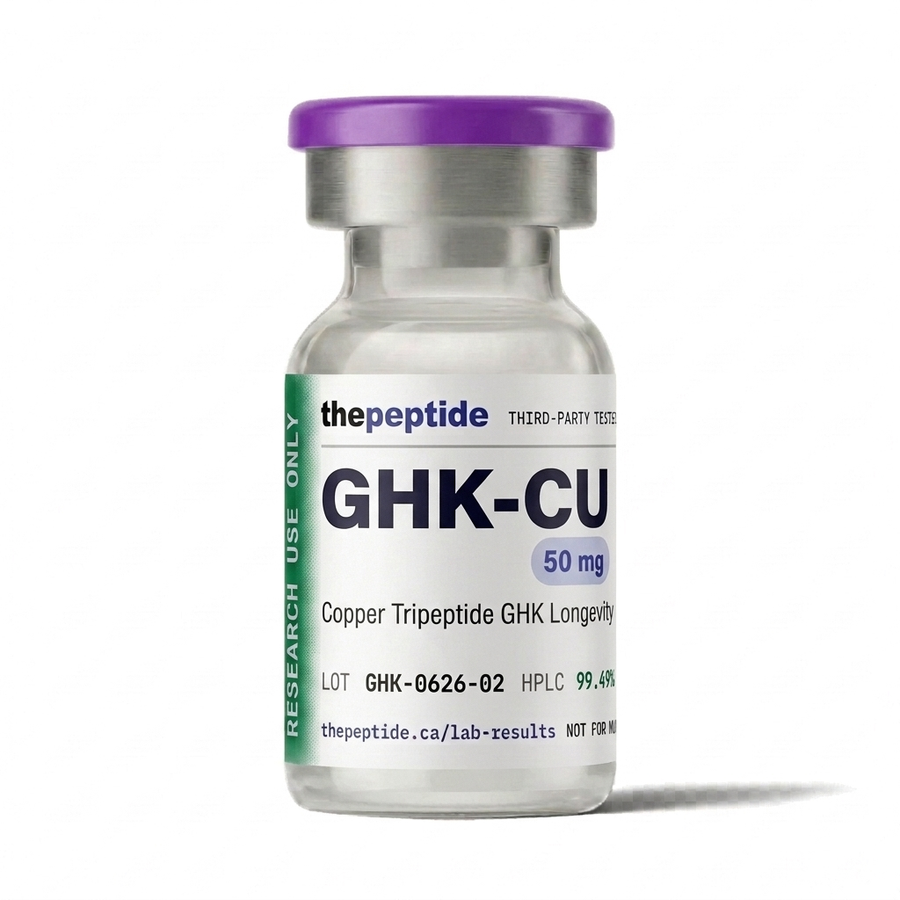

GHK-Cu 50mg
Copper-Binding Tripeptide (GHK-Cu)Testides certificate, lot GHK50-0626-02. 99.93% by HPLC-UV at 214 nm; projected content 68.67 mg vs 50 mg label. Enter report ARUA-GHK-50-092026 at testides.com/verify.
✓ Certificate held — lot GHK50-0626-02, Testides (Toronto)
Assayed by Testides, Toronto, Canada, report ARUA-GHK-50-092026, run 25 September 2026 and reported 28 September 2026: 99.93% purity by HPLC-UV at 214 nm, and a projected content of 68.67 mg against a 50 mg label weight.
Testides verifies this report by the document itself: upload the original PDF at testides.com/verify and it is checked against the laboratory's released copy. Email info@thepeptide.ca and we will send you the PDF · All lot results
GHK-Cu is the copper(II) complex of glycyl-L-histidyl-L-lysine, a three-residue peptide first isolated from human plasma, supplied here as 50 mg of lyophilised powder for laboratory research use only.
Lot GHK50-0626-02 was sent to Testides in Toronto by us, not by the manufacturer. It came back at 99.93% HPLC purity with one trace impurity at 0.07%, and the laboratory's content calculation came to 68.67 mg in a vial labelled 50 mg. We publish both figures, and we publish what the report does not establish, because a certificate is only as useful as the reader's understanding of what it measured.
Chemically, GHK-Cu is CAS 89030-95-5, formula C14H22CuN6O4, molecular weight 401.91 g/mol. The free tripeptide GHK (C14H24N6O4) is 340.38 g/mol; the difference is the bound copper ion, less the two protons it displaces. That distinction matters when reading any content figure, because milligrams of GHK-Cu and milligrams of GHK are not the same quantity. The content question below explains why that is relevant to this lot.
What makes GHK-Cu interesting as a reagent is that it is small, endogenous and defined by a metal. The peptide was identified in 1973 as a plasma factor that prolonged the survival of cultured liver cells, and the copper chemistry was worked out through the early 1980s: GHK binds Cu(II) tightly, and much of the later literature treats the complex as a copper-delivery and signalling molecule in extracellular-matrix and wound-model systems rather than as a hormone. The powder is blue. That colour is the copper, and it is expected.
The evidence base is also narrower than most vendor pages suggest. It is largely cell culture and animal wound models, a large share of it comes from one research group, and the human data are almost entirely topical cosmetic studies. The research sections below set out what has been measured, and where the claims run ahead of it.
For laboratory and research use only. Not for human consumption, veterinary use, or therapeutic application. Not approved by Health Canada. We do not provide preparation, dilution or administration guidance for any compound we sell.
Read the full research guide →Shipping is free and tracked, Canada-wide, on every order, with no minimum. Orders are dispatched within 48 hours, Monday to Friday, from British Columbia. Estimated delivery: 2–8 business days.
Sealed, unopened vials are exchangeable within 14 days of delivery. Report damage within 48 hours of the expected delivery date.