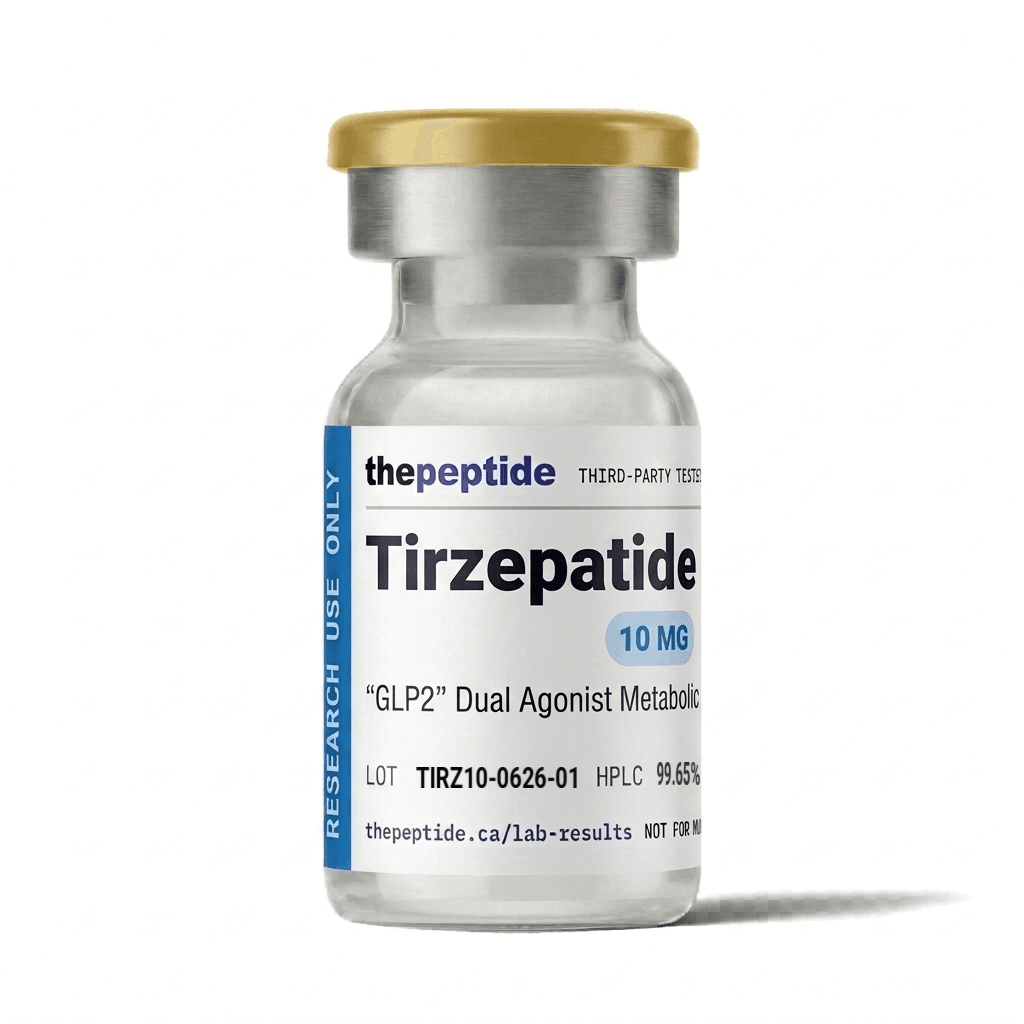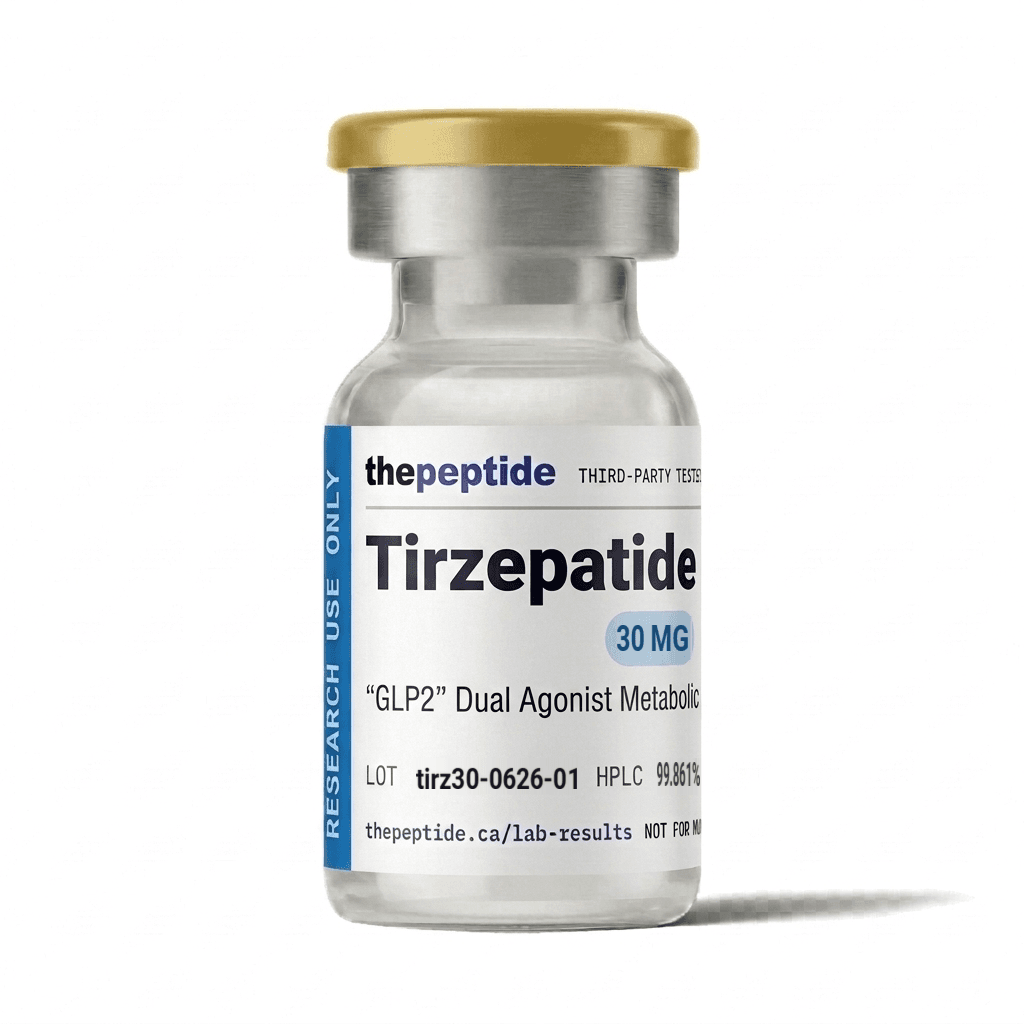
Tirzepatide 30mg
Dual GIP/GLP-1 Receptor Agonist — 30mg Vial✓ Blind-tested — lot tirz30-0626-01, Janoshik Analytical report #246529
Submitted to Janoshik Analytical as an unidentified sample on a common GLP-1 peptide panel — semaglutide, tirzepatide or retatrutide, the laboratory was not told which — and identified by the laboratory as tirzepatide. Analysis conducted 30 October 2026: 99.861% purity by HPLC, with measured net peptide content 33.06 mg against a 30 mg label weight, a fill accuracy of 110.2%.
Our own confirmatory certificate on this lot is still pending; the 10 mg vial holds a Testides certificate, this one does not yet. All lot results · How to read a peptide COA
Tirzepatide is a single 39-residue peptide built on the GIP backbone and engineered to agonise both the GIP and the GLP-1 receptor, supplied here as 30 mg of lyophilised powder for laboratory research.
At $150.00 the 30 mg vial is $5.00 per nominal milligram against $7.50/mg for the 10 mg vial — a third less, and $4.54 per milligram actually measured on this lot's 33.06 mg. Thirty milligrams as three 10 mg vials costs $224.97; as one vial it costs $150.00.
The arithmetic is the obvious reason to buy this size and the weaker one. The stronger reason has nothing to do with money: a dose–response curve or a timecourse run from a single lot contains no inter-lot variability, and a lot change partway through a series introduces a confounder that cannot be corrected retrospectively. Purity and measured content both differ between lots — 103.4% fill on the 10 mg lot against 110.2% here — so part of the difference between an early and a late condition can be the vial rather than the biology.
Three modifications make the molecule work, and each has a job. α-aminoisobutyric acid at position 2 blocks the dipeptidyl peptidase-4 cleavage site. Aib at position 13 stabilises the helix. Lys²⁰ carries 1,20-eicosanedioic acid, a C20 fatty diacid tethered through γ-glutamic acid and two AEEA spacers, which drives the albumin binding behind an elimination half-life Health Canada gives as approximately five days. The C-terminus is amidated. Formula C₂₂₅H₃₄₈N₄₈O₆₈, molecular weight 4813 Da, CAS 2023788-19-2, development code LY3298176.
What makes tirzepatide interesting as a reagent rather than merely as a commercial product is that it is not a balanced dual agonist. Willard and colleagues found substantially greater occupancy at the GIP receptor than at the GLP-1 receptor at efficacious exposures, and different behaviour at each: native-like at GIPR, and at GLP-1R biased toward cAMP over β-arrestin recruitment with weaker receptor internalisation than GLP-1 itself. In primary islets β-arrestin1 limited the insulin response to GLP-1 but not to GIP or tirzepatide. That is a testable hypothesis for why a dual agonist outperforms a selective one, and the reason this vial belongs in a comparative panel alongside semaglutide and retatrutide.
The evidence record is deep and does not point one way. Tirzepatide beat semaglutide on weight and glycaemic endpoints in two open-label head-to-head trials; on hard cardiovascular outcomes SURPASS-CVOT met non-inferiority against dulaglutide but not superiority, while semaglutide holds placebo-controlled outcome superiority from SELECT. Both are below, next to each other, because publishing only the favourable half is how this category lost its credibility.
This vial is supplied strictly as a laboratory reagent. We publish no dosing, route, schedule, titration or administration guidance of any kind.
For laboratory and research use only. Not for human consumption, veterinary use, or therapeutic application. Not approved by Health Canada. We do not provide preparation, dilution or administration guidance for any compound we sell.
Read the full research guide →Shipping is free and tracked, Canada-wide, on every order, with no minimum. Orders are dispatched within 48 hours, Monday to Friday, from British Columbia. Estimated delivery: 2–8 business days.
Sealed, unopened vials are exchangeable within 14 days of delivery. Report damage within 48 hours of the expected delivery date.
Janoshik Analytical received this sample as an unknown on a common GLP-1 peptide panel — semaglutide, tirzepatide and retatrutide were the candidates, and the laboratory was not told which it was. It identified the material as tirzepatide, reported 99.861% purity by HPLC and 33.06 mg of net peptide against a 30 mg label, with analysis conducted 30 October 2026 under report #246529.
The value of the format is that identity was established without the label's help. An ordinary certificate confirms purity while assuming the vial contains what the box says; a blind panel makes the laboratory decide between three closely related acylated incretin analogues on the analysis alone.
Because the label describes the nominal fill and the certificate describes the peptide. Lyophilised material carries counter-ions, residual water and bound solvent, all of which have mass, so a vial filled to a nominal 30 mg of powder and a vial containing 30 mg of peptide are not the same object. This one measured 33.06 mg of tirzepatide — a fill accuracy of 110.2%.
Every GLP-1-family lot we have published has come in above label: 10.34 mg against 10 on the tirzepatide 10 mg vial, 24.51 against 20 and 34.20 against 30 on the larger retatrutide vials. That is a direction, not a promise. Calculate concentrations from the measured figure on the certificate rather than from the number printed on the label.
It is cheaper — $5.00/mg against $7.50/mg, so 30 mg costs $150.00 here against $224.97 as three 10 mg vials. But the stronger argument is methodological. A dose–response curve or a timecourse drawn from a single lot contains no inter-lot variability; change lot partway through and you have introduced a variable that cannot be corrected retrospectively.
It is not always the right purchase. A 30 mg fill concentrates the handling risk into one container, and stability liabilities in this class are handling-driven rather than intrinsic. For a one-off assay, or anything that leaves a stock reconstituted for weeks, three 10 mg vials are the better buy despite costing more.
Because we send lots for our own confirmatory testing selectively and in order, and this one has not come back. Every batch is assayed by Janoshik Analytical before release; the confirmation is a second, independent measurement that we commission ourselves. The tirzepatide 10 mg vial has cleared both steps and holds a Testides certificate. This lot has cleared the first.
It is labelled “tested once, second lab pending” on the lab results page and will stay that way until the second certificate exists. Tested once is a statement about how many laboratories have reported, not a doubt about the peptide.
By how many receptors it engages and which backbone it is built on. Semaglutide is a GLP-1 analogue — one receptor. Tirzepatide is built on the GIP sequence and agonises both the GIP and GLP-1 receptors. Retatrutide adds a third arm at the glucagon receptor, which points metabolically the opposite way from the other two.
All three share the same engineering logic: a non-proteinogenic residue blocking DPP-4 cleavage, and a fatty diacid driving albumin binding so the molecule survives long enough to matter. The differences are in the backbone and in which receptors the result reaches.
Willard and colleagues found that at clinically efficacious exposures tirzepatide occupies the GIP receptor substantially more than the GLP-1 receptor, and that it behaves differently at each. At GIPR it mimics native GIP. At GLP-1R it favours cAMP generation over β-arrestin recruitment and drives weaker receptor internalisation than GLP-1 itself.
In primary islets, β-arrestin1 limited the insulin response to GLP-1 but not to GIP or to tirzepatide. That is a mechanistic hypothesis for why a dual agonist outperforms a selective one — and it is testable in a comparative signalling panel, which is the kind of work a 30 mg single-lot vial exists for.
It is area-percent: of everything the detector registered, 99.861% eluted as a single peak. It describes what else is in the vial, and at that level the practical reading is that the synthesis and purification were clean.
It says nothing about how much peptide the vial contains — that is the separate net content figure, 33.06 mg — and nothing about endotoxin, which is a different assay we have not run on this lot. A high purity figure and a high content figure are two independent pieces of information and both are published here.
Yes, and without going through us. Janoshik publishes a direct link for report #246529; it is on this page and on the lab results page, and it opens the laboratory's own record rather than a copy we host. No login, no request form.
The certificate names the manufacturer's batch, CS-ze30-1020, where the vial label prints our own lot code tirz30-0626-01. The two refer to the same material — the first is the batch as the supplier shipped it, the second is how it is tracked here — and both are published so the chain can be followed in either direction.
Lyophilised: −20 °C for long-term storage, 2–8 °C short-term, sealed, desiccated and protected from light. Conventional laboratory diluents are sterile water or an aqueous buffer, or bacteriostatic water where multi-use aliquots are wanted.
Prepare single-use aliquots at first reconstitution so a working stock is never repeatedly thawed, and do not re-freeze thawed material. Reconstituted-stability windows circulating on vendor pages come from supplier technical monographs rather than published forced-degradation work on this molecule, and we present none of them as established.
Licensed pharmaceutical products developed from this molecule are authorised by Health Canada under their own brand names and their own manufacturing controls. This vial is not one of them. It is an unformulated research peptide, it carries no Drug Identification Number, and it is supplied for laboratory use only.
The clinical record exists because those licensed products went through regulated development. It is not evidence about the contents of this vial, and we do not present it as though it were.
Tirzepatide beat semaglutide on weight and glycaemic endpoints in two head-to-head trials, both open-label and one against a comparator dose that was not the weight-management dose. SURMOUNT-1 (Jastreboff et al., NEJM 2022, PMID 35658024) is the reference for the weight data.
On hard cardiovascular outcomes the ranking reverses: SURPASS-CVOT met non-inferiority against dulaglutide but not superiority, while semaglutide holds placebo-controlled outcome superiority from SELECT. We publish both because a page that carried only the first would be selling rather than informing.
Free tracked shipping Canada-wide with no minimum, dispatched from British Columbia within 48 hours. We ship within Canada only. Payment is by Interac e-Transfer.
Every lot's figures are published under its own lot number on the lab results page before it goes on sale, which is the same page you can use to check the number printed on a vial you already hold.