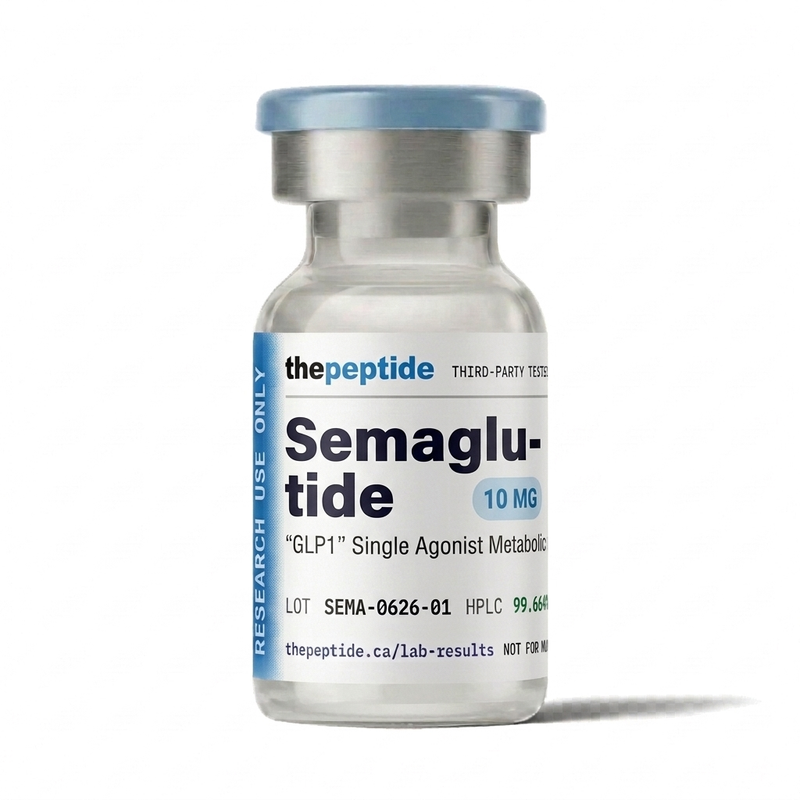
Semaglutide 10mg
GLP-1 Receptor Agonist
✓ Third-party tested — Janoshik report #171488
Assayed by Janoshik Analytical, report #171488, analysis conducted June 2026: 99.664% purity by HPLC, measured peptide content 11.42 mg against a 10 mg nominal fill.
This lot is Janoshik-only. Testides (Toronto) confirmation is pending and no Testides certificate exists for it. Only four lots on this site currently hold one, and neither Semaglutide size is among them. That is a factual limit on what has been independently corroborated, and we would rather state it than dress a single-laboratory result in plural language.
Semaglutide is the most heavily trialled compound sold on this site, and the 10 mg vial is the size that lets a single lot cover an entire experimental series — 10 mg of lyophilised acylated GLP-1 analogue, supplied for laboratory research.
Most peptides in this catalogue are characterised by a handful of rodent papers and an unsettled mechanism. Semaglutide is the opposite problem. It carries randomised, double-blind, placebo-controlled human evidence running to tens of thousands of participants across the SUSTAIN, STEP and SELECT programmes, three Health Canada authorisations under three brand names, and — since April 2026 — the first generic semaglutide approved in any G7 country. The difficulty with writing about it is not finding evidence. It is that the volume of evidence lets almost any claim find a citation, so what a page like this is actually for is saying which findings are load-bearing and which are not.
The molecule itself is a 31-residue analogue of GLP-1(7-37) with three engineered changes: Ala⁸ → α-aminoisobutyric acid, which sterically blocks the dipeptidyl peptidase-4 cleavage that destroys native GLP-1 within a minute or two; Lys³⁴ → Arg, which leaves a single lysine so acylation has one unambiguous target; and a C18 octadecanedioic diacid on Lys²⁶, tethered through γ-glutamic acid and two oligoethylene-glycol spacers, which drives reversible albumin binding. Health Canada's product monograph attributes the resulting half-life of approximately one week to albumin binding reducing renal clearance together with increased stability towards DPP-4. Formula C₁₈₇H₂₉₁N₄₅O₅₉, molecular weight 4113.6 Da, CAS 910463-68-2. The 5 mg page takes the chemistry apart modification by modification; this page assumes it and goes to the evidence, the manufacturing question and the Canadian regulatory picture.
On price, the 10 mg vial at $69.99 is $7.00 per nominal milligram against $9.00/mg for the 5 mg vial — a 22% lower unit cost. Adjusted for this lot's measured content of 11.42 mg it is $6.13 per milligram actually present. That is the arithmetic. The stronger argument for the larger vial has nothing to do with money: a series of experiments run from one lot has no inter-lot variability in it, and a lot change partway through a dose–response or timecourse series introduces a confounder that cannot be corrected retrospectively.
This vial is supplied strictly as a laboratory reagent. We publish no dosing, route, schedule or administration guidance of any kind. The clinical record described below exists because licensed pharmaceutical products were developed from this molecule under regulatory oversight — it is not evidence about an unformulated research peptide, and we do not present it as though it were.
For laboratory and research use only. Not for human consumption, veterinary use, or therapeutic application. Not approved by Health Canada. We do not provide preparation, dilution or administration guidance for any compound we sell.
Key specifications
- CAS: 910463-68-2
- Molecular weight: 4,113.58 g/mol
- Class: GLP-1 receptor agonist
- Purity: 99.664% (HPLC)
Specifications
| Compound | Semaglutide, lyophilised powder, 10 mg |
|---|---|
| Synonyms / development code | NN9535; NNC 0113-0217. Licensed product brands: Ozempic, Wegovy, Rybelsus |
| Compound class | Acylated GLP-1 receptor agonist; lipidated incretin mimetic (class-B1 GPCR agonist) |
| CAS number | 910463-68-2 |
| Molecular formula | C₁₈₇H₂₉₁N₄₅O₅₉ |
| Molecular weight | 4113.6 Da (Health Canada product monograph); 4113.64 g/mol average |
| Sequence (one-letter, Aib as X) | HXEGTFTSDVSSYLEGQAAK*EFIAWLVRGRG (* = acylated Lys) |
| Sequence (three-letter) | His-Aib-Glu-Gly-Thr-Phe-Thr-Ser-Asp-Val-Ser-Ser-Tyr-Leu-Glu-Gly-Gln-Ala-Ala-Lys(C18-diacid-γGlu-OEG-OEG)-Glu-Phe-Ile-Ala-Trp-Leu-Val-Arg-Gly-Arg-Gly |
| Peptide length | 31 residues; 94% sequence homology to human GLP-1; no disulfide bonds; free C-terminal acid |
| Modifications vs GLP-1(7-37) | Ala⁸ → Aib; Lys³⁴ → Arg; Lys²⁶ acylated with octadecanedioic (C18) diacid via γGlu + 2 × OEG |
| Vial contents | 10 mg lyophilised semaglutide, white to off-white, no excipient, sealed vial |
| Current lot / report | Janoshik report #171488, analysis June 2026 |
| Verified purity | 99.664% |
| Measured content | 11.42 mg per vial (10 mg label) |
| Test method | HPLC purity and quantitative content determination. No mass-spectrometry identity line on this report |
| Testing laboratory | Janoshik Analytical, independent third party. Testides (Toronto) confirmation pending — no Testides certificate on this lot |
| Storage | Lyophilised: −20 °C long-term, 2–8 °C short-term; sealed, desiccated, protected from light |
| Research applications | Multi-condition GLP-1R dose–response and timecourse series from a single lot; cAMP accumulation and β-arrestin recruitment assays; receptor internalisation and trafficking; albumin-binding and protein-displacement work; comparative incretin pharmacology against dual and triple agonists; plasma-stability and DPP-4 resistance assays; RP-HPLC and LC-MS/MS method development and system-suitability standard |
| Related compounds | Semaglutide 5mg · Tirzepatide 10mg · Retatrutide 10mg · Retatrutide 20mg · Bacteriostatic water 10ml |
| Ships from | British Columbia, Canada — free tracked shipping Canada-wide, dispatched within 48 hours |
| Intended use | Laboratory research only — in vitro and preclinical. Not a drug; not for human or veterinary use |
Lab Results
- Sealed vial: −20°C, 24+ months.
- Protect from light and heat.
- Keep in original packaging until use in the laboratory.
How should this vial be stored and reconstituted in the laboratory?
Bench handling only. No dosing, route, schedule or administration guidance is given or implied.
Dry material. −20 °C for long-term holding, 2–8 °C for short-term, sealed and desiccated and protected from light. Bring the vial to room temperature before opening — lyophilised peptide is hygroscopic and cold powder condenses atmospheric moisture the moment the seal is broken.
Treat it as a surfactant, because that is what the C18 chain makes it. Semaglutide is amphiphilic by design. Three practical consequences follow. Material adsorbs to hydrophobic surfaces, so dilute solutions in untreated polypropylene lose measurable peptide to the tube wall — a low-binding tube or a carrier protein is worth considering for very dilute work. Agitation is genuinely damaging: shaking or vortexing drives the molecule to the air–liquid interface where it denatures and aggregates, so add diluent slowly down the vial wall and swirl or roll. And lipidated GLP-1 analogues self-associate into oligomers in a concentration- and pH-dependent fashion, so a stock prepared at one concentration is not a linearly scaled version of one prepared at another — this is the usual explanation when a dilution series behaves non-linearly at the top end.
Degradation chemistry. There is no cysteine and no methionine, so disulfide scrambling and thioether oxidation — the two pathways that dominate most peptide stability discussions — do not apply here. What does apply is backbone hydrolysis and aspartate isomerisation at acidic pH, and base-mediated cleavage of the amide bond linking the acyl chain to Lys²⁶. That last one produces des-acyl semaglutide: a species with essentially normal receptor pharmacology and a completely different half-life, which makes it invisible to a functional assay and obvious to a chromatographic one. It is the impurity worth resolving if you are developing a stability-indicating method.
Reconstitution. Conventional laboratory diluents are sterile water or an aqueous buffer; bacteriostatic water where multi-use aliquots are wanted. Aliquot into single-use volumes at first reconstitution and do not re-freeze thawed material — with a 10 mg fill this matters more than with a 5 mg one, simply because the vial will be drawn on more times. Commonly circulated reconstituted-stability windows come from supplier technical monographs rather than published forced-degradation work on this molecule, and we present none as established. In-use periods on the licensed injectable products belong to buffered, preserved, tonicity-adjusted solutions and do not transfer to unformulated peptide.
As a dry lyophilisate the material tolerates ambient temperature for the length of domestic transit, which is why no cold chain is used. Move it to −20 °C on arrival.
How fast does this ship within Canada, and what does delivery cost?
Free tracked shipping Canada-wide on every order, with no minimum spend. Orders are dispatched within 48 hours, Monday to Friday, from our facility in British Columbia, and a tracking number is emailed when the label is generated. The vial is already in Canada, so a domestic order has no international leg, no customs clearance and no brokerage fee.
Vials are packed dry and sealed with protective padding in plain outer packaging, with the lot identifier on the label so it can be checked against the published report figures. Transit estimates by province and current dispatch status: shipping information.
Can I return a vial, and what is covered if an order arrives damaged?
Report transit damage or non-delivery to info@thepeptide.ca within 48 hours of the expected delivery date, with your order number and photographs of the outer packaging and the vial where applicable. Confirmed damage in transit and confirmed non-delivery are resolved by replacement or refund.
Sealed, unopened vials in original condition can be exchanged within 14 days of delivery. Nothing that has been opened, punctured, reconstituted or otherwise prepared can be accepted back: once the seal is broken there is no way to verify temperature history, light exposure or chain of custody, and material of unknown handling history will not be returned to circulation.
Governing terms, including how money is refunded and to which payment method: refund policy.
Are Ozempic, Wegovy and Rybelsus the same drug, and why does one molecule have three names?
Same active moiety, three products, and the differences are formulation and indication rather than chemistry. This confuses buyers constantly and the confusion has a real consequence, because one of the three is not pharmacologically equivalent to the others.
Ozempic — subcutaneous, type 2 diabetes
Semaglutide injection, Novo Nordisk Canada, DIN 02471469, first marketed in Canada 22 February 2018, currently Marketed. The dose range is the diabetes range, which is the detail that makes SURPASS-2's comparator arm a limited head-to-head — see the tirzepatide comparison below.
Wegovy — subcutaneous, higher dose, weight management
Same molecule at a higher maintenance dose. Health Canada approval announced 25 November 2021. The current Canadian monograph also carries an indication for reducing non-fatal myocardial infarction risk in adults with established cardiovascular disease, and a non-cirrhotic MASH indication with moderate-to-advanced fibrosis that is authorised with conditions pending confirmatory trials.
Rybelsus — oral tablet, and genuinely different
Oral semaglutide, Health Canada approval 9 April 2020, in Canadian pharmacies from 27 April 2020, later extended to cardiovascular risk reduction in type 2 diabetes. The tablet is co-formulated with an absorption enhancer, and the milligram figures on the tablet are not comparable to the injectable ones at all — oral bioavailability for a 4 kDa peptide is very low, so the oral and subcutaneous dose scales differ by roughly two orders of magnitude. Anyone reading across from a tablet strength to anything else has made a category error.
None of these is what is in this vial. A licensed product is a formulated drug: buffer, tonicity agent, preservative, a defined fill, a stability dossier and a shelf life. This is unformulated lyophilised peptide with none of that. The correspondence is chemical, not pharmaceutical, and the trial evidence attaches to the products rather than to the powder.
How is semaglutide manufactured, and does the production route change what is in the vial?
This is the most under-discussed question in the category, and the honest answer includes an admission.
The licensed drug substance is not purely synthetic. Health Canada's Ozempic product monograph states that semaglutide is "produced by recombinant DNA technology in Saccharomyces cerevisiae." The 31-residue backbone, including the non-proteinogenic Aib at position 8, is produced biologically and the C18 diacid side chain is then attached chemically. That hybrid route is why the drug substance has the impurity profile it has.
Research-grade material is generally made a different way. The common route for research peptides of this length is solid-phase synthesis, sometimes with fragment condensation, followed by on-resin or solution-phase acylation and preparative HPLC. The two routes converge on the same molecule but not on the same impurity population: a recombinant route carries host-cell protein and expression-related variants, a synthetic route carries deletion and truncation sequences, capped failure sequences and residual coupling reagents. Neither is inherently better characterised — they are differently characterised.
What we do not know about this lot. We do not publish a synthesis route for it, because the report we hold is an HPLC purity and content assay and does not establish one. We will not state "solid-phase synthesised" as a fact about material whose route we have not verified, and a vendor page asserting a manufacturing route without a document behind it is asserting something it cannot know either.
One consequence worth carrying into the lab. Synthetic peptides are typically isolated as acetate or trifluoroacetate salts, and residual TFA is not pharmacologically inert in cell culture — it can suppress proliferation in sensitive lines at concentrations that arrive with the peptide rather than being added deliberately. Quantitative content determination measures peptide mass and so is the right basis for a molar calculation, but if a cell-based assay is behaving oddly at high peptide concentration, the counter-ion is a candidate that almost nobody checks. We report no salt form for this lot because none was assayed.
What does the cardiovascular outcome evidence actually show?
Two trials carry it, and the second is the reason semaglutide occupies a different evidentiary position from every other compound in this catalogue.
SUSTAIN-6 (2016) was a randomised, double-blind, placebo-controlled cardiovascular safety trial in type 2 diabetes. Its job was to demonstrate non-inferiority — the regulatory requirement for diabetes drugs since 2008 — and it went further, which is what put cardiovascular benefit on the agenda for this class at all.
SELECT (2023) is the substantive one, because it removed diabetes from the equation. 17,604 participants with established cardiovascular disease, BMI ≥ 27, and no diabetes, randomised double-blind against placebo, mean follow-up 40 months. The primary composite was cardiovascular death, non-fatal myocardial infarction and non-fatal stroke, with all-cause mortality among the secondary measures. The trial met its primary endpoint against placebo.
Three limits that belong next to that result.
1. The relative risk reduction is the figure that gets quoted; the absolute difference over more than three years is considerably smaller, and it is the absolute difference that describes the size of the effect.
2. Everyone enrolled already had cardiovascular disease. This is secondary-prevention evidence. It says nothing about anyone without established disease.
3. 16.6% of the semaglutide group discontinued because of adverse events, against 8.2% on placebo — double the rate, predominantly gastrointestinal, in a trial where participants had every incentive to continue. That figure is a fair summary of real-world tolerability and it is almost never quoted alongside the hazard ratio.
Why it matters on a research page: SELECT is the reason semaglutide is the appropriate comparator in incretin pharmacology. It is the GLP-1 agonist with placebo-controlled outcome superiority, so any newer agent's claim to improvement is measured against a real benchmark rather than a surrogate one. As the tirzepatide page sets out, that benchmark has not yet been matched on cardiovascular outcomes by anything else in the class.
Is semaglutide on the WADA Prohibited List?
No. It is on the Monitoring Programme, which is a separate document and carries no sanction. Vendor pages across this category assert or imply a ban; the assertion is simply incorrect, and getting it right is more useful than repeating it.
The Monitoring Programme is the list of substances WADA watches to detect patterns of misuse without prohibiting them. Semaglutide was added to it in 2024, and WADA has since funded analytical work on detecting GLP-1 receptor agonists in blood and dried blood spots — which is exactly what monitoring means: build the assay, observe the prevalence, decide later.
The decision point arrived and went the same way. On 10 September 2026 WADA's Executive Committee confirmed GLP-1 receptor agonists would not be added to the 2027 Prohibited List, retaining Monitoring Programme status. Professor Olivier Rabin, WADA's senior director for science and medicine, paired the announcement with advice to athletes to be careful using these drugs without medical supervision — which is a safety caution, not a prohibition, and the two are frequently conflated in secondary reporting.
The fallback argument competitors reach for is section S0, Non-Approved Substances. S0 covers substances with no current approval by any governmental regulatory health authority for human therapeutic use. Semaglutide holds authorisations from Health Canada, FDA and EMA, so the substance is outside S0 by the clause's own wording. What S0 can reach is a specific unapproved preparation, which is a different question from the molecule's status and one no product page can answer for a particular sample.
Qualifications we will not leave out: the Prohibited List and Monitoring Programme are reissued annually, so this is a statement about 2026 and the announced 2027 list, not a permanent finding; and this is our reading of published WADA documents, not a determination by WADA. Any athlete in a tested sport should get a written determination from their national anti-doping organisation rather than rely on a vendor's reading, ours included.
What did Health Canada authorise, and what happened to the Canadian patent?
The Canadian story diverged from the rest of the world in 2026, and it did so because of an unpaid administrative fee. It is the single most consequential jurisdiction-specific fact about this molecule and it is almost entirely absent from vendor pages written for a US audience.
The patent lapsed. Novo Nordisk's Canadian composition-of-matter patent, CA 2,601,784, "Acylated GLP-1 compounds," went abandoned when a maintenance fee of roughly CAD $250 was not paid in 2019; the last payment on record was received 23 October 2018. With its supplementary term the patent would otherwise have run to 20 March 2028. Novo Nordisk retains other Canadian patents, and the litigation position is genuinely contested, but the composition patent itself is gone.
Generics followed, first in the G7. Health Canada approved Dr. Reddy's Laboratories' generic semaglutide on 28 April 2026 and Apotex's on 1 May 2026, and stated it was reviewing further submissions with additional decisions expected. Health Canada's own release noted that generics in Canada are commonly 45–90% cheaper than the brand-name product. No other G7 country has approved a generic semaglutide.
Why a research-peptide page should tell you this. The demand that built the grey market for GLP-1 peptides was created by price and supply of the licensed product. That is the condition a Canadian buyer is now reasoning inside, and it changed materially this year. A page that quietly implies the only route to this molecule is an unregulated one is not describing the Canadian market as it stands in 2026.
None of which makes this vial an authorised drug. Approved semaglutide products in Canada are Ozempic (DIN 02471469, marketed since 22 February 2018), Rybelsus (approved 9 April 2020) and Wegovy (approval announced 25 November 2021), plus the newly authorised generics. This vial is an unapproved research reagent and holds no DIN, no NPN and no authorisation of any kind.
Where does semaglutide fail, and what remains unresolved?
The effect does not persist after withdrawal, and this is measured. The STEP 1 trial extension followed 327 participants for 52 weeks after treatment stopped at week 68. Body-weight change was measured on treatment to week 68 and again off treatment to week 120, against placebo. Off treatment, semaglutide participants regained much of the weight lost. The authors report that cardiometabolic improvements "reverted towards baseline at week 120 for most variables." Roughly two-thirds of the effect returned. STEP 4, a randomised withdrawal design, showed the same asymmetry prospectively.
Body composition is not what these trials measured. STEP 1's endpoint was percent change in body weight, measured against placebo over 68 weeks in 1,961 participants. Weight is not fat mass. Claims about lean-tissue preservation or loss require DXA or equivalent body-composition endpoints that the pivotal weight trials largely did not prespecify, and the question of what proportion of the loss is lean tissue is still genuinely open rather than settled in either direction.
Response is heterogeneous and the averages hide it. STEP 1 reported the proportion of participants reaching a predefined weight-loss threshold against placebo, and a substantial minority of treated participants did not reach it. Individual variance around the mean in these trials is large, and a mean is not a prediction.
Tolerability is a real constraint, not a footnote. Health Canada's Wegovy review summary records gastrointestinal disorders in 73% of participants, headache 16%, fatigue 11%, and describes a 16-week dose-escalation schedule designed specifically to mitigate GI effects. SELECT's 16.6% versus 8.2% discontinuation gap is the same finding measured at scale.
The MASH indication is conditional. The Canadian Wegovy monograph carries the non-cirrhotic MASH indication as authorised with conditions, Health Canada's mechanism for approving on promising but incomplete evidence pending confirmatory trials. That is a weaker regulatory status than a standard authorisation and describing it as an approval without the qualifier overstates it.
And the boundary on all of it: this evidence describes a licensed pharmaceutical product with a defined formulation, not an unformulated research peptide, and there is no clinical evidence of any kind about the latter.
How were the semaglutide and tirzepatide head-to-head trials designed?
Two head-to-head trials exist. Both favour tirzepatide on weight and glycaemic endpoints. Both are open-label, which matters for subjective and behaviour-mediated endpoints, and one of them uses a comparator dose that is not the weight-management dose at all.
SURPASS-2 (2021) — type 2 diabetes, 40 weeks, n = 1,879, open-label
Escalating tirzepatide doses versus semaglutide 1 mg, measuring HbA1c and body weight. The comparator was the diabetes dose, not the higher weight-management dose. This trial cannot answer how tirzepatide compares with semaglutide as used for weight management, and it was not designed to.
SURMOUNT-5 (2025) — obesity without diabetes, 72 weeks, n = 751, open-label
Maximum tolerated tirzepatide versus maximum tolerated semaglutide, measuring body weight and waist circumference. This is the fair dose comparison of the two, and it favoured tirzepatide on those measures.
Then the part that gets left out. Weight and HbA1c are not the only endpoints, and on hard cardiovascular outcomes the ranking reverses. SELECT tested semaglutide against placebo and showed superiority on the MACE composite. SURPASS-CVOT tested tirzepatide against active comparator dulaglutide in 13,165 participants over a median four years and met non-inferiority (P = 0.003) but not superiority (P = 0.09), hazard ratio 0.92. Those are different questions with different answers, and no trial has yet compared tirzepatide with semaglutide on cardiovascular outcomes.
So the accurate statement is narrow: tirzepatide produces greater weight and glycaemic effects in open-label head-to-head trials; semaglutide has the only placebo-controlled cardiovascular outcome superiority in the class. Which is the right comparator for a given experiment depends entirely on which of those the experiment is about. Full treatment on the Tirzepatide 10mg page; for the triple-agonist arm of the same question see Retatrutide 10mg.
Does the 10 mg vial change anything except the price per milligram?
Yes, and the non-price reason is the better one.
The arithmetic first. This vial is $69.99, or $7.00 per nominal milligram. The 5 mg vial is $44.99, or $9.00 per nominal milligram — a 28.6% higher unit price for the smaller fill, or put the other way, the 10 mg vial costs 22% less per milligram. Adjusted for measured content the gap narrows slightly but holds: $6.13/mg here on 11.42 mg measured, against $7.44/mg on the 5 mg lot's 6.05 mg.
The experimental-design reason. Lot-to-lot variation is a real source of variance even between high-purity lots: different synthesis or purification batches carry different impurity populations, and measured content differs — 6.05 mg on one fill against 11.42 mg on another is not the same fraction of nominal. If a dose–response series, a timecourse and a set of replicates all come from one vial, that variance is eliminated by construction. If a lot change happens partway through, it becomes a confounder no statistical adjustment can undo after the fact. Estimate total requirement before ordering and buy one fill that covers it.
The argument against. A larger fill only helps if it is actually used. Semaglutide's C18 acyl chain makes it surface-active, so material is lost to tube walls and to air–liquid interfaces, and repeated freeze–thaw of a reconstituted stock is the principal avoidable degradation route. A 10 mg vial reconstituted for a small experiment and then cycled repeatedly is worse than a 5 mg vial consumed cleanly. Aliquot at first reconstitution or take the smaller size.
Both sizes are single sealed fills with no excipient, and each is characterised by its own report. Purity and content figures do not transfer between them — check the identifier on the label against the published figures for that lot. The 5 mg page covers the chemistry of each modification and the compounding-regulation question in detail; this page covers manufacturing route, brand equivalence and the Canadian patent situation. They are worth reading together rather than treating as duplicates.
What does report #171488 cover, and what does "Testides confirmation pending" mean?
Janoshik Analytical, report #171488, analysis conducted June 2026: purity 99.664%, measured peptide content 11.42 mg against a 10 mg nominal fill. Report numbers for every current lot are indexed on our lab results page.
Purity is the fraction of chromatographic peak area belonging to the target peptide, which is a statement about what the peptide present is — intended sequence versus truncations, deletions, des-acyl species or degradation products. Content is the absolute mass, which is a statement about how much. They answer different questions, and a vendor quoting only purity has told you nothing about the quantity you are about to weigh into a calculation. Measured content here runs about 14% above the nominal fill, which is ordinary for lyophilised fills but is more than enough to shift a concentration series if you assume 10.00 mg. Walkthrough: how to read a peptide COA.
"Testides confirmation pending" means exactly what it says. Testides is a Toronto laboratory we use for second-laboratory corroboration. Four lots on this site currently hold a Testides certificate: Tirzepatide 10mg (99.65%), Retatrutide 10mg (99.68%), BPC-157 10mg (99.64%) and the Wolverine Blend. This lot is not one of them. It has one laboratory's result, not two, and we label it accordingly.
What report #171488 does not cover: no mass-spectrometry identity confirmation, no endotoxin or microbial bioburden testing, no residual solvent or heavy-metal analysis, no aggregation assessment, no counter-ion determination.
Why the distinction earns its space: independent analyses of grey-market peptide samples have repeatedly found mislabelling, concentration errors and contamination at meaningful rates. A lot-specific third-party report is the minimum defence against that, and a percentage typed onto a product page with no report identifier behind it is not evidence of anything. A number you can trace to a report, from a lot that matches the label in front of you, is.
Which trials underpin the semaglutide record, and how were they designed?
Each citation was checked against a MEDLINE-derived record or a publisher page. Design and size are given because they determine what each result can and cannot support.
1. Lau J, Bloch P, Schäffer L, et al. Discovery of the Once-Weekly Glucagon-Like Peptide-1 (GLP-1) Analogue Semaglutide. J Med Chem. 2015;58(18):7370–7380. PMID 26308095. — In vitro and animal. The Aib⁸ and Arg³⁴ substitutions, Lys²⁶ derivatisation, GLP-1R affinity 0.38 ± 0.06 nM (about threefold weaker than liraglutide), and a 46.1 h plasma half-life in mini-pigs after intravenous administration.
2. Marso SP, et al. Semaglutide and Cardiovascular Outcomes in Patients with Type 2 Diabetes. N Engl J Med. 2016;375(19):1834–1844. PMID 27633186. — SUSTAIN-6. Randomised, double-blind, placebo-controlled. The first cardiovascular outcome data for the molecule.
3. Wilding JPH, et al. Once-Weekly Semaglutide in Adults with Overweight or Obesity. N Engl J Med. 2021;384(11):989–1002. PMID 33567185. — STEP 1. Randomised, double-blind, placebo-controlled, n = 1,961, 68 weeks, measuring percent change in body weight against placebo. Endpoint was weight, not body composition.
4. Rubino D, et al. Effect of Continued Weekly Subcutaneous Semaglutide vs Placebo on Weight Loss Maintenance: The STEP 4 Randomized Clinical Trial. JAMA. 2021;325(14):1414–1425. PMID 33755728. — Randomised withdrawal design after a 20-week run-in. Continuation versus withdrawal, prospectively.
5. Wilding JPH, Batterham RL, Davies M, et al. Weight regain and cardiometabolic effects after withdrawal of semaglutide: The STEP 1 trial extension. Diabetes Obes Metab. 2022. doi:10.1111/dom.14725. PMID 35441470. — n = 327 followed to week 120, measuring weight regained off treatment; cardiometabolic variables reverted towards baseline for most measures. Final volume and page range not confirmed against a primary record, so DOI and PMID are given instead.
6. Lincoff AM, Brown-Frandsen K, Colhoun HM, et al. Semaglutide and Cardiovascular Outcomes in Obesity without Diabetes. N Engl J Med. 2023;389(24):2221–2232. PMID 37952131. — SELECT. Randomised, double-blind, placebo-controlled, n = 17,604, mean follow-up 40 months, measuring a MACE composite and all-cause mortality against placebo; discontinuation for adverse events 16.6% versus 8.2%.
7. Frías JP, Davies M, Rosenstock J, et al. Tirzepatide versus Semaglutide Once Weekly in Patients with Type 2 Diabetes. N Engl J Med. 2021;385(6):503–515. PMID 34170647. — SURPASS-2. Randomised but open-label, n = 1,879, 40 weeks, comparator semaglutide 1 mg — the diabetes dose, not the weight-management dose.
8. Aronne LJ, et al. Tirzepatide as Compared with Semaglutide for the Treatment of Obesity. N Engl J Med. 2025;393(1):26–36. PMID 40353578. — SURMOUNT-5. Phase 3b, randomised, open-label, n = 751, 72 weeks, measuring body weight. The fair-dose head-to-head.
9. Nicholls SJ, et al. Cardiovascular Outcomes with Tirzepatide versus Dulaglutide in Type 2 Diabetes. N Engl J Med. 2025;393:2409–2420. PMID 41406444. — SURPASS-CVOT. Randomised, double-blind, active-comparator non-inferiority, n = 13,165, median four-year follow-up. HR 0.92; non-inferiority met (P = 0.003), superiority not met (P = 0.09). Included here because it is the trial that keeps the cardiovascular comparison honest.
Mix any research peptides 10 mg or larger — the discount counts your whole order, not one product.
YOU MAY ALSO LIKE
SHOP ALL
Frequently Bought Together
Laboratory supplies commonly ordered alongside research compounds.
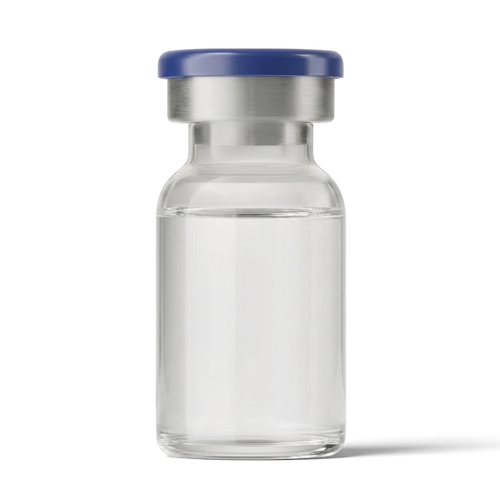
Bacteriostatic Water 10mL — Sterile Multi-Use Laboratory Water with 0.9% Benzyl Alcohol
Sterile Preserved Laboratory Water
STARTING AT ▸ $22.00