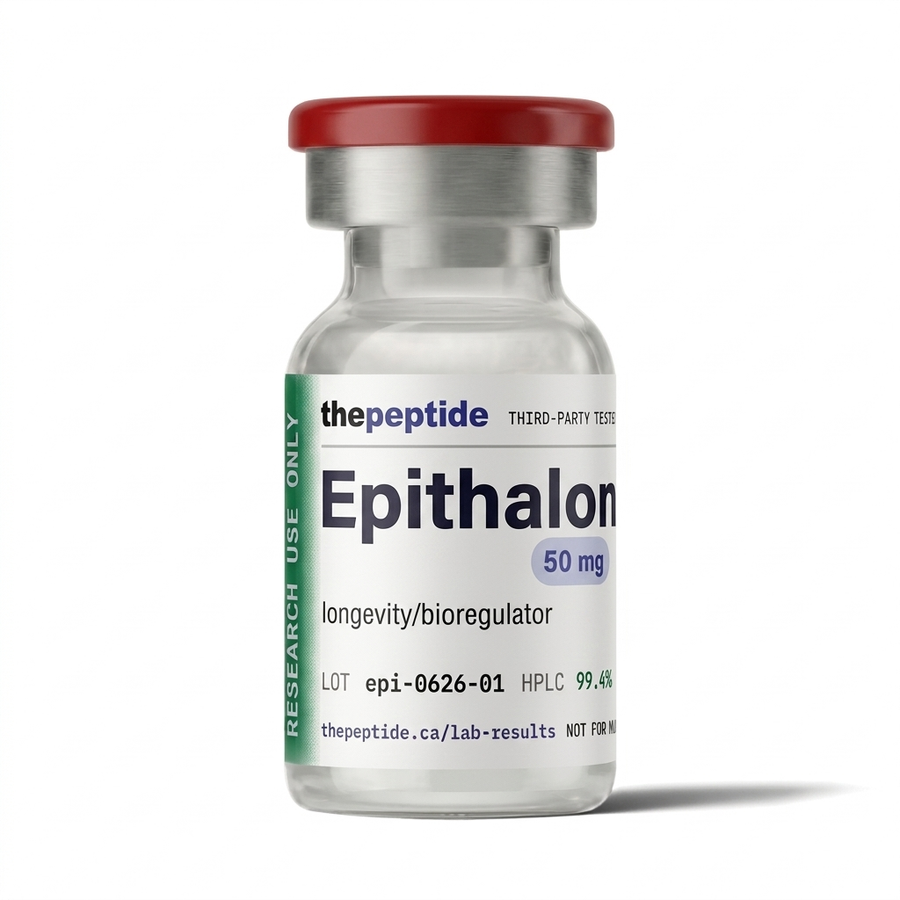
Epithalon 10mg
Pineal Tetrapeptide BioregulatorJanoshik Analytical report #230585, analysed 14 September 2026 — 99.004% purity and 11.75 mg of peptide against a 10 mg label. Commissioned by the manufacturer; our own confirmation is pending. Manufacturer batch CS-ep10-0902. Verify key 6NXMK64ULMK2 at janoshik.com/verify.
Independent certificate published — in stock
This Epithalon lot has been independently tested. Lot epi10-0626-01 measured HPLC 99% purity and 11.75 mg content (Janoshik report #230585), and the lot's third-party certificate of analysis — covering identity by mass spectrometry and purity by HPLC — is published on this page, with its lot number on it; our confirmatory Testides test on this lot is still in progress. We do not borrow another lot's figures to fill the gap. See every published result on our lab results page.
Epithalon (also written Epitalon, and known by its sequence code AEDG) is a single synthetic tetrapeptide, Ala-Glu-Asp-Gly, supplied here as lyophilised powder for laboratory research use only.
Epithalon was designed at the St. Petersburg Institute of Bioregulation and Gerontology by Vladimir Khavinson and colleagues as a short, chemically defined peptide corresponding to the putative active fragment of epithalamin — a polypeptide extract of the bovine pineal gland that the same group had studied since the 1970s. That origin is the single most important thing to hold onto when reading anything written about this compound, because almost every popular summary silently merges the two. Epithalamin is a crude multi-peptide extract; Epithalon is one four-residue molecule. They are not interchangeable, and the distinction decides how much of the published record actually applies to the powder in the vial. The mechanism and evidence sections below keep them separate on purpose, because most vendor pages do not.
Chemically, Epithalon is CAS 307297-39-8, molecular formula C14H22N4O9, average molecular weight 390.35 Da, PubChem CID 219042, FDA UNII O65P17785G. The sequence is H-Ala-Glu-Asp-Gly-OH — alanine, glutamic acid, aspartic acid, glycine, free at both the N- and C-termini, with no amidation, no acylation, no non-proteinogenic residues and no modifications of any kind. It is one of the smallest peptides sold as a research reagent: a bare, highly hydrophilic acidic tetrapeptide with a net negative charge at neutral pH from its two carboxylic-acid side chains. There is nothing exotic about the molecule itself. What is contested is what it does.
Epithalon sits inside a larger idea that is worth stating because it shapes every claim made about the molecule. Khavinson's group built a programme around short "peptide bioregulators" — two- to four-residue peptides, each tied to a particular tissue, proposed to carry tissue-specific regulatory information: Epithalon (AEDG) for the pineal gland, Thymalin and the dipeptide Vilon for the thymus, and others for vessels, bone and brain. The organising hypothesis is that these peptides are small enough to enter the cell and the nucleus and to interact directly with DNA, tuning the expression of a narrow set of genes rather than acting at a surface receptor. This is an unusual proposed mechanism, and it is the reason the compound is described as a "bioregulator" rather than an agonist or inhibitor. A researcher evaluating Epithalon should treat that whole framework as a hypothesis under test — coherent, internally consistent, and still largely unconfirmed outside the group that proposed it.
Two research mechanisms dominate the literature, and both come overwhelmingly from one network of investigators. The first is telomere biology. In cultured human somatic cells, Khavinson's group reported that Epithalon induced telomerase activity and lengthened telomeres, letting human fetal fibroblasts divide past the classical Hayflick limit (Khavinson et al., Bull Exp Biol Med 2003;135(6):590-592, PMID 12937682; and 2004;137(5):503-506, PMID 15455129). The second is pineal and circadian signalling: Epithalon and its parent extract have been reported to restore age-related declines in nocturnal melatonin and to normalise circadian rhythm in aged animals and elderly cohorts. Khavinson's framing is that these short peptides act as bioregulators — ligands that reach DNA and modulate gene expression — rather than as receptor-agonist drugs. That model is a hypothesis, not a settled mechanism, and we present it as one.
The honest frame matters more here than for almost any compound we list. The great majority of the Epithalon and epithalamin literature originates from a single research group, much of it published in one journal and a substantial portion only in Russian. The long-term human cohort reports that are routinely quoted as evidence for Epithalon used epithalamin — the extract — not the isolated synthetic tetrapeptide. There is no well-conducted, independent, blinded, placebo-controlled human trial of synthetic Epithalon, and no published Phase I safety study of it. The most useful recent development is a 2025 independent in-vitro study at Brunel University London (Al-dulaimi et al., Biogerontology 2025;26:178) that revisited the telomere question in human cell lines — the first serious replication attempt from outside the originating network, and even its authors confined their conclusions to cell culture. Read the whole record as hypothesis-generating preclinical and mechanistic research, not as established biology. Our Epithalon research guide sets out the evidence claim by claim, including which studies used the extract rather than the peptide.
Epithalon is investigational and approved nowhere as a medicine. There is no Health Canada authorisation and no Drug Identification Number, no FDA approval and no EMA approval. Health Canada named Epitalon specifically, by that spelling, in its public advisory of 9 April 2026 on peptides bought online, stating that such products have not been assessed for safety, efficacy or quality, that they are illegal to sell in Canada, and — the sentence a research vendor is obliged to reproduce rather than hide — that labelling a product "For Research Use Only" does not make it legal to use in people. We supply this vial as a laboratory reagent and for no other purpose.
For laboratory and research use only. Not for human consumption, veterinary use, or therapeutic application. Not approved by Health Canada. We do not provide preparation, dilution or administration guidance for any compound we sell. For related research tools see our MOTS-C and GHK-Cu pages, or browse the full peptide library.
Shipping is free and tracked, Canada-wide, on every order, with no minimum. Orders are dispatched within 48 hours, Monday to Friday, from British Columbia. Estimated delivery: 2–8 business days.
Sealed, unopened vials are exchangeable within 14 days of delivery. Report damage within 48 hours of the expected delivery date.