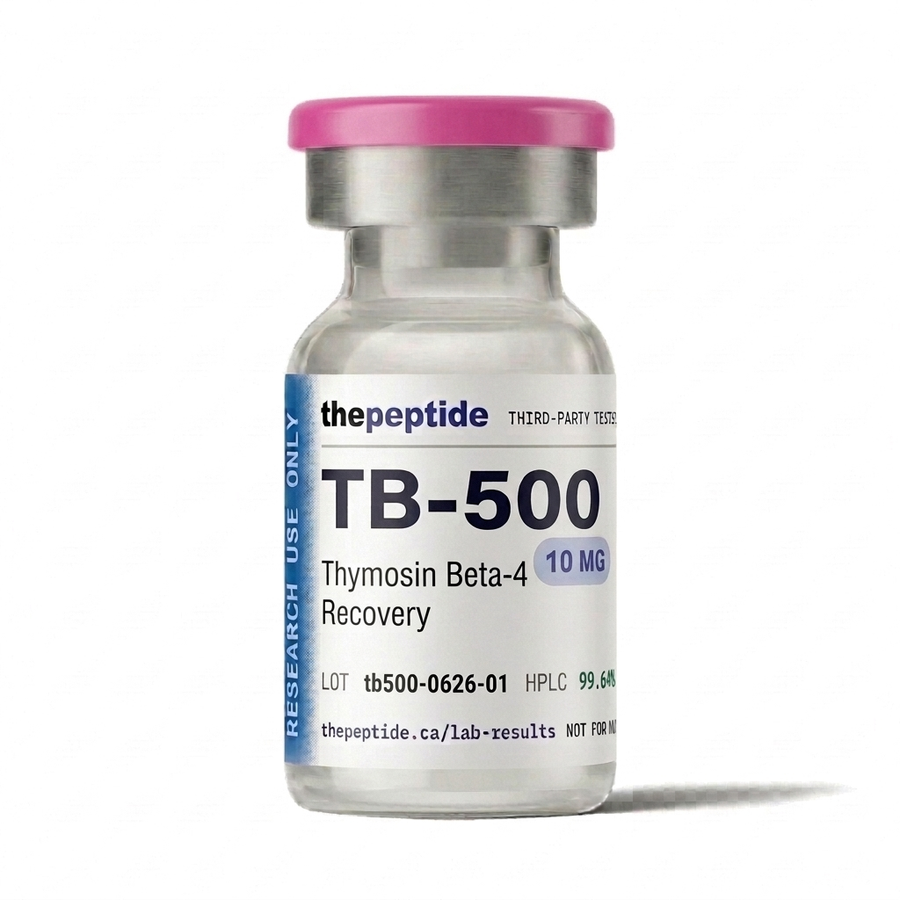
TB-500 10mg
Thymosin β4 Active FragmentIndependent certificate published — in stock
This lot has been independently assayed. Lot tb50010-0626-01 measured HPLC 99.766% purity and 11.99 mg peptide content (Janoshik report #147070). The independent certificate of analysis — HPLC-UV purity with mass-spectrometric identity confirmation — is published with its lot number on our lab results page; our confirmatory Testides test on this lot is still in progress. We do not list purity numbers we have not measured.
TB-500 is a synthetic, N-terminally acetylated seven-residue peptide, Ac-Leu-Lys-Lys-Thr-Glu-Thr-Gln (Ac-LKKTETQ), corresponding to residues 17–23 of the 43-residue regulatory protein thymosin β4 (Tβ4). It is supplied here as lyophilised powder for laboratory research use only — a defined reference material for in-vitro work on actin dynamics, cell migration and tissue-repair signalling.
The single most important thing to understand about this compound is on the label, and almost no vendor states it plainly: TB-500 and thymosin β4 are not the same molecule. Thymosin β4 is a full 43-amino-acid protein — roughly 4,921 Da, CAS 77591-33-4 — found in nearly every mammalian cell and in blood and wound fluid, where it is the principal actin-sequestering peptide. "TB-500," by its most precise and most commonly cited definition, is a far smaller synthetic fragment: the acetylated heptapeptide Ac-LKKTETQ, roughly 889 Da, CAS 885340-08-9, reproducing only the central actin-binding region of the parent protein. One is a cytokine-sized regulatory protein; the other is a short peptide a fraction of its mass. Treating published Tβ4 data as though it were TB-500 data — which much of the market does — is the central error this page exists to correct.
The name also sits on a real research distinction. The conserved motif LKKTET is the hexapeptide shared across the β-thymosin family and has been mapped as central to how thymosin β4 contacts monomeric actin (Van Troys et al., EMBO J 1996;15(2):201–210, PMID 8617196). TB-500 extends that motif by one glutamine (LKKTETQ) and caps the N-terminus with an acetyl group, giving the heptapeptide marketed and sold as "TB-500." So the fragment is not an arbitrary cut — it is built around the actin-binding sequence. What it is not is a complete stand-in for the whole protein, and that caveat runs through everything below.
What thymosin β4 does at the molecular level is well characterised. It binds globular (monomeric, G-) actin in a roughly 1:1 complex and holds a large intracellular reserve of unpolymerised actin — in some motile cells Tβ4 is present at tens to hundreds of micromolar, buffering a substantial fraction of the free G-actin pool. When a cell receives a migration or repair cue, that sequestered actin can be released for rapid filament (F-actin) assembly at the leading edge. By tuning the monomer reserve, Tβ4 influences cytoskeletal remodelling, directed cell migration, and downstream programmes including angiogenesis and matrix turnover. This is the mechanism investigators have studied in wound re-epithelialisation, corneal repair and post-infarction cardiac models (reviewed in Goldstein, Hannappel & Kleinman, Trends Mol Med 2005;11(9):421–429, PMID 16099219; and Goldstein, Hannappel, Sosne & Kleinman, Expert Opin Biol Ther 2012;12(1):37–51, PMID 22074294).
The honest nuance is about the fragment specifically. The isolated LKKTET/LKKTETQ region is necessary for and central to actin binding, and synthetic peptides containing the actin-binding domain have reproduced several of the parent protein's regenerative activities in defined assays — for example promoting dermal wound repair in diabetic and aged mice (Philp et al., Wound Repair Regen 2003;11(1):19–24, PMID 12581422). But the short peptide binds actin far more weakly than the intact protein, and it lacks domains of Tβ4 that carry other activities entirely — notably the N-terminal Ac-SDKP tetrapeptide (residues 1–4, also called seraspenide) associated with anti-fibrotic and anti-inflammatory effects, and the N-terminal helical region linked to cytoprotection. So "TB-500 reproduces the actin-binding activity of thymosin β4" is defensible; "TB-500 does everything thymosin β4 does" is not.
The landmark tissue-repair studies used the full protein. Full-length Tβ4 accelerated skin wound healing with increased re-epithelialisation and vessel density (Malinda et al., J Invest Dermatol 1999;113(3):364–368, PMID 10469335); activated integrin-linked kinase and Akt to promote cardiomyocyte survival and migration and reduce scarring after coronary ligation in mice (Bock-Marquette et al., Nature 2004;432(7016):466–472, PMID 15565145); and mobilised adult epicardial progenitors to drive neovascularisation (Smart et al., Nature 2007;445(7124):177–182, PMID 17108969). Human work has likewise used the full peptide: phase 1 intravenous safety in healthy volunteers (Ruff et al., Ann N Y Acad Sci 2010, PMID 20536472) and ophthalmic formulations (RGN-259 eye drops) taken into phase 2/3 trials for dry eye and neurotrophic keratopathy (e.g. NCT03937882; PMID 36613994). Where a finding on this page belongs to full Tβ4 rather than the Ac-LKKTETQ fragment, we say so.
The honest regulatory frame. Neither TB-500 nor thymosin β4 is an approved drug anywhere. There is no Health Canada authorisation and no Drug Identification Number; no FDA or EMA approval. Health Canada named TB-500 specifically in its public advisory of 9 April 2026 (identification number RA-81874) warning against peptides bought online, alongside BPC-157, GHK-Cu, MOTS-c and others — and stated that labelling a product "for research use only" does not make it legal to sell for injection. Thymosin β4 and its fragments are also prohibited in sport under the World Anti-Doping Agency framework (growth-factor class), and TB-500 has repeatedly been detected as a doping agent in racehorses. None of the published research supports a human therapeutic claim, and we make none.
We sell this vial as a laboratory reagent and nothing else. It pairs naturally with our BPC-157 for comparative tissue-repair work and appears alongside BPC-157 in our healing ("Wolverine") blend; related reagents in this area include GHK-Cu, the glow blend and MOTS-c. For reconstitution we stock bacteriostatic water. See the peptide library for comparative context and lab results for certificates as lots are released.
For laboratory and research use only. Not for human consumption, veterinary use, or therapeutic application. Not approved by Health Canada. We do not provide preparation, dilution or administration guidance for any compound we sell.
Shipping is free and tracked, Canada-wide, on every order, with no minimum. Orders are dispatched within 48 hours, Monday to Friday, from British Columbia. Estimated delivery: 2–8 business days.
Sealed, unopened vials are exchangeable within 14 days of delivery. Report damage within 48 hours of the expected delivery date.
No — and this is the distinction that matters most before you compare any datasheet or price. Thymosin β4 (Tβ4) is the full endogenous protein: 43 amino acids, approximately 4,921 Da, CAS 77591-33-4, present in almost every mammalian cell and in blood and wound fluid, where it is the principal actin-sequestering peptide. TB-500, by its most precise and most widely cited definition, is a synthetic fragment of that protein: the N-terminally acetylated heptapeptide Ac-LKKTETQ (Ac-Leu-Lys-Lys-Thr-Glu-Thr-Gln), roughly 889 Da, CAS 885340-08-9, corresponding to residues 17–23 of Tβ4.
So the two are related the way a sentence is related to a paragraph it was lifted from. The fragment is built around the conserved LKKTET motif — the β-thymosin actin-binding sequence mapped by Van Troys and colleagues (EMBO J 1996;15(2):201–210) — extended by one glutamine and acetyl-capped. It reproduces the actin-binding portion of the parent protein while being far smaller and cheaper to synthesise. What it does not reproduce are the other functional regions of the full protein, including the N-terminal Ac-SDKP tetrapeptide linked to anti-fibrotic activity. A large fraction of the market blurs this by selling the full 43-residue protein as "TB-500," so before buying or citing anything, confirm the exact sequence and molecular weight: ~889 Da is the fragment; ~4,921 Da is the whole protein. This vial is the fragment, Ac-LKKTETQ, supplied for laboratory research only.
This is the question that separates honest sourcing from marketing, and the answer is uncomfortable for most "TB-500" listings: the great majority of the influential published research used full-length thymosin β4, not the Ac-LKKTETQ heptapeptide.
The landmark wound-healing paper (Malinda et al., J Invest Dermatol 1999;113(3):364–368) used the full protein. The two Nature cardiac papers that made Tβ4 famous — integrin-linked kinase activation and cardiomyocyte survival after infarction (Bock-Marquette et al., 2004;432(7016):466–472) and adult epicardial progenitor mobilisation (Smart et al., 2007;445(7124):177–182) — used the full protein. Human phase 1 safety (Ruff et al., Ann N Y Acad Sci 2010) and the RGN-259 ophthalmic trials used the full protein. When a product page attributes "accelerated healing" or "cardiac repair" to TB-500, it is almost always borrowing full-Tβ4 data.
There is genuine fragment-specific evidence, and it is narrower. Philp and colleagues (Wound Repair Regen 2003;11(1):19–24) showed that a synthetic peptide containing the actin-binding domain promoted dermal wound repair in diabetic and aged mice, reproducing part of the parent protein's effect. More recent analytical work has characterised TB-500 the heptapeptide and its rapid metabolism specifically. The honest rule we apply on this page: where a finding belongs to full Tβ4, it is labelled as full Tβ4; where it belongs to the fragment, it is labelled as the fragment. An efficacy claim that quietly swaps one for the other is not evidence about the molecule in this vial.
The core mechanism is G-actin sequestration. Actin exists in two forms: free monomers (globular, or G-actin) and polymerised filaments (F-actin). Cell movement, division and shape change all depend on rapidly assembling and disassembling filaments, which means a cell needs a controlled reserve of monomer ready to deploy. Thymosin β4 is the main peptide that supplies and regulates that reserve.
Full Tβ4 binds a single molecule of monomeric actin in a roughly 1:1 complex, holding it in a non-polymerisable state. In motile cells Tβ4 is abundant — present at tens to hundreds of micromolar — so it buffers a large share of the free G-actin pool. When a migration or repair signal arrives, sequestered monomer is released and fed onto growing filaments at the leading edge, letting the cell extend and move. By setting the size of this buffered monomer pool, Tβ4 tunes cytoskeletal remodelling, directed cell migration toward injury, and downstream programmes that depend on it — endothelial migration in angiogenesis, keratinocyte migration in re-epithelialisation, and extracellular-matrix remodelling.
The physical contact point is the LKKTET motif, the conserved β-thymosin sequence mapped to the actin interface by mutational analysis (Van Troys et al., EMBO J 1996;15(2):201–210). That is exactly the region the TB-500 fragment (Ac-LKKTETQ) is drawn from, which is why the fragment carries actin-binding character at all. Downstream, full Tβ4's repair effects have been tied to integrin-linked kinase and Akt signalling in the cardiac work (Bock-Marquette et al., Nature 2004). For a general mechanistic overview, Goldstein, Hannappel and Kleinman's reviews (Trends Mol Med 2005;11(9):421–429; Expert Opin Biol Ther 2012;12(1):37–51) are the standard references.
This is where honest sourcing earns its keep, because the usual shorthand — "TB-500 is the active site, so it does what Tβ4 does" — overstates the case. The accurate position is more careful.
The LKKTET motif is necessary for and central to actin binding: mutational mapping places the actin contact in this region (Van Troys et al., EMBO J 1996). But the same structural work shows that high-affinity binding of the intact protein also involves its N-terminal segment and an α-helical region flanking the motif. Strip the protein down to a short acetylated hexa- or heptapeptide and you keep the recognition sequence but lose much of the surrounding structure, so the isolated fragment binds monomeric actin far more weakly than full Tβ4. It is a reduced mimic, not an equal substitute, for the quantitative actin-sequestering capacity of the whole molecule.
What the fragment has been shown to do is reproduce specific downstream activities in defined assays — for instance, a synthetic actin-binding-domain peptide promoted dermal wound repair in diabetic and aged mice (Philp et al., Wound Repair Regen 2003;11(1):19–24). That is a real result about the fragment. It is not the same claim as "the heptapeptide sequesters actin with the affinity of the native protein," which the biophysics does not support. For a research reagent this distinction is practical: an assay that assumes the fragment behaves stoichiometrically like intact Tβ4 — the same 1:1 buffering at the same concentrations — will misread its data. If your experiment depends on quantitative actin sequestration, the full protein and the fragment are not interchangeable inputs, and we will not pretend they are.
The published record is real, is mostly preclinical, and is mostly about the full protein. Taken in order:
Mechanism. Van Troys et al. (EMBO J 1996;15(2):201–210) mapped the actin-binding site to the LKKTET region. Goldstein, Hannappel and Kleinman reviewed the actin-sequestering-to-tissue-repair biology (Trends Mol Med 2005;11(9):421–429; Expert Opin Biol Ther 2012;12(1):37–51).
Wound healing. Full Tβ4 accelerated re-epithelialisation and increased vessel density in rodent skin wounds (Malinda et al., J Invest Dermatol 1999;113(3):364–368). A synthetic actin-binding-domain peptide — fragment-level evidence — promoted repair in diabetic and aged mice (Philp et al., Wound Repair Regen 2003;11(1):19–24).
Cardiac. Full Tβ4 activated integrin-linked kinase and Akt, promoting cardiomyocyte survival and migration and reducing scar after coronary ligation in mice (Bock-Marquette et al., Nature 2004;432(7016):466–472), and mobilised adult epicardial progenitors to drive neovascularisation (Smart et al., Nature 2007;445(7124):177–182).
Human. Full Tβ4 reached phase 1 intravenous safety testing in healthy volunteers (Ruff et al., Ann N Y Acad Sci 2010) and early ophthalmic trials (RGN-259 eye drops) for dry-eye disease and neurotrophic keratopathy (e.g. NCT03937882; PMID 36613994). How strong is this? Preclinical signals are consistent and mechanistically coherent; human data are limited to early-phase safety and small ophthalmic studies, with no large outcome trials and no approved indication. The evidence supports studying actin-dependent repair biology — not a human therapeutic claim.
Just as important as what is published is what is not, and a reagent vendor has an obligation to state the gaps rather than paper over them.
It does not support a human therapeutic claim. There is no approved indication for TB-500 or thymosin β4 in any country. Human data are confined to early-phase safety and small ophthalmic trials; there are no large randomised outcome trials for wound healing, injury recovery, muscle, tendon or cardiac endpoints, and no mortality or long-term safety data.
It does not support equating the fragment with the full protein. Most headline findings are full-Tβ4 results. The isolated Ac-LKKTETQ heptapeptide binds actin far more weakly than the intact protein and lacks the Ac-SDKP and N-terminal regions that carry Tβ4's anti-fibrotic and cytoprotective activities, so fragment efficacy cannot simply be read off full-protein studies.
It does not support "systemic healing" extrapolations. Accelerated re-epithelialisation in a mouse wound or reduced scar in a ligated mouse heart are specific model readouts; they are not evidence of whole-body tendon, ligament or "recovery" benefit in any species, and certainly not in humans.
It raises an unresolved angiogenesis caution. Because the biology is pro-angiogenic and pro-migratory, a theoretical concern about tumour vascularisation has been raised in the literature; published sources note no demonstrated human cancer link, but the question is open rather than closed. And the fragment is pharmacokinetically short-lived — analytical studies show TB-500 the heptapeptide is rapidly metabolised — so in-vitro exposure and any in-vivo exposure are not comparable. None of these gaps is a reason to avoid the compound as a research reagent; they are reasons not to overstate it.
They are frequently studied together in tissue-repair models, but they are structurally and mechanistically distinct compounds, and conflating them is a common error.
TB-500 is the acetylated heptapeptide Ac-LKKTETQ (CAS 885340-08-9, ~889 Da), the actin-binding fragment of thymosin β4. Its proposed mechanism runs through actin dynamics: G-actin sequestration by the parent protein, modulation of the monomer reserve, and the resulting effects on cytoskeletal remodelling, directed cell migration and angiogenesis.
BPC-157 is a synthetic 15-residue peptide (a "pentadecapeptide") derived from a sequence identified in human gastric juice (Body Protection Compound). Its research literature centres on a different set of pathways — angiogenic signalling associated with the VEGFR2/eNOS axis, nitric-oxide-system interactions, and models of tendon, ligament, muscle and gastrointestinal repair — rather than on actin sequestration.
Because the two propose different upstream mechanisms that could plausibly converge on the shared endpoints of angiogenesis and tissue repair, they are often run side by side or in combination — which is exactly the rationale for our healing ("Wolverine") blend that contains both. For a clean comparative experiment, the useful design is to run standalone BPC-157, standalone TB-500, and the combination against the same assay, so the contribution of each mechanism can be separated. One caution shared by both: neither is an approved drug, both appear on the same Health Canada advisory, and comparisons here are for research context only — not a ranking of therapeutic value, which neither compound has established.
They are different products for different experiments. This listing is standalone TB-500 — the single compound Ac-LKKTETQ, supplied on its own as a defined reference material. Our healing ("Wolverine") blend is a combination product containing both BPC-157 and TB-500 in a single vial.
Choose the standalone when you need to attribute an effect to one mechanism. If an assay is meant to probe actin-dependent migration, or to characterise the Ac-LKKTETQ fragment specifically — its identity, purity, concentration-response or metabolism — then a single-compound vial is the correct input, because a blend confounds the two peptides and makes it impossible to say which drove the result.
Choose the blend when the experimental question is explicitly about the combination — for example comparing a two-peptide mixture against each peptide alone on a shared repair endpoint. In a properly designed comparative study you would typically want all three arms available: standalone BPC-157, standalone TB-500 (this page), and the combined blend, each assayed against the same model. Note that the nickname "Wolverine" is informal vendor shorthand for the combination; it is not a pharmacological designation and implies nothing about healing capacity in any organism. Both the blend and the standalone are sold strictly for laboratory research use only.
Because they identify two different molecules, and mixing them up corrupts both your chemistry records and any literature comparison you build on them.
CAS 885340-08-9 is the TB-500 fragment: Ac-LKKTETQ, molecular formula C38H68N10O14, average mass about 889 Da, PubChem CID 62707662, UNII QHK6Z47GTG. That is the compound on this page.
CAS 77591-33-4 is full-length thymosin β4: the 43-residue protein, sequence Ac-SDKPDMAEIEKFDKSKLKKTETQEKNPLPSKETIEQEKQAGES, average mass about 4,921 Da. That is a different substance with a different formula, a different mass, and a different PubChem record.
Why it matters in practice: a mass-spectrometry identity check expects ~889 Da for the fragment and ~4,921 Da for the protein, so the CAS/formula/mass you record must match what the instrument actually sees — a vial sold as "TB-500" that returns a ~4,921 Da parent ion is full Tβ4, however it is labelled. It also matters for citing literature: if you anchor a fragment experiment to full-Tβ4 papers (or vice versa) because both were filed under "TB-500," your reference trail is wrong at the source. When our COA is published it will state the molecular weight and the identity method, so the number on the certificate can be matched to the molecule you intend to study. If a supplier cannot tell you which CAS number, formula and mass their "TB-500" corresponds to, that is the whole problem in miniature.
TB-500 is not an approved product in Canada. It has no Health Canada authorisation, no Drug Identification Number (DIN), and is not approved by the FDA, the EMA or any other regulator. It is an investigational research chemical, sold here strictly for laboratory research use — not as a drug, supplement or food, and not for human or veterinary use.
Health Canada named TB-500 specifically in its public advisory of 9 April 2026 (identification number RA-81874), "Think twice before injecting peptides bought online," listing it alongside BPC-157, CJC-1295, GHK-Cu, ipamorelin, MOTS-c and others. The advisory states these products have not been assessed for safety, efficacy or quality, that selling them for human use is illegal in Canada, and — the sentence a research-peptide vendor has an obligation to reproduce rather than hide — that labelling a product "for research use only" does not make it legal to sell for injection. We sell this vial as a laboratory reagent and we do not sell it for administration to anyone, for any purpose.
In sport, it is prohibited. Thymosin β4 and its fragments fall under the World Anti-Doping Agency's prohibited growth-factor category, prohibited at all times (in and out of competition); TB-500 has repeatedly been identified as a doping agent in racehorses, and dedicated detection methods exist in equine and human anti-doping. Any athlete subject to anti-doping rules should treat TB-500 as prohibited. None of this is administration guidance — it is the regulatory status of the compound, which we state in full rather than bury.
Every lot is independently assayed before we treat its figures as real. Lot tb50010-0626-01 has been assayed by HPLC at 99.766% purity with 11.99 mg measured peptide content (Janoshik report #147070), and its independent certificate of analysis is published with the lot number on it. Our confirmatory Testides test on this lot is still in progress.
What the certificate shows: the independent certificate of analysis carries two separate measurements. Purity is determined by HPLC-UV and reported as area-percent — the target peak's area divided by the total area of everything the detector sees — which for a short peptide like this counts truncations and related species in the denominator. Identity is confirmed by mass spectrometry: for the Ac-LKKTETQ fragment the expected average mass is about 889 Da, and the MS result is what distinguishes the genuine heptapeptide from full-length thymosin β4 (~4,921 Da) sold under the same name. The certificate carries its lot number so it can be matched to the vial in hand, and it is posted openly on our lab results page, not held behind an email gate.
We make no purity claim we cannot back with a lot-numbered certificate. A "99%+" figure with no lot number, no wavelength and no identity method is a marketing asset, not a record — and for this compound specifically, a purity number means little if the identity test was never run to confirm the vial contains the fragment rather than the full protein. For how to read a certificate, see our guide on how to read a peptide COA.
Lyophilised, sealed and desiccated: −20 °C for long-term holding, protected from light and moisture. The dry powder is the stable form and tolerates brief ambient exposure during shipping without meaningful loss, so the cold requirement applies to storage, not to the transit leg.
On reconstitution, use an appropriate sterile solvent for laboratory handling (bacteriostatic or sterile water is conventional). Hold reconstituted solution at 2–8 °C for short-term use and at −20 °C or below for longer storage, and aliquot before freezing: divide a stock into single-use volumes at first preparation so no working fraction is thawed more than once. Repeated freeze–thaw cycling is the most common avoidable cause of peptide loss. Do not return thawed material to the freezer.
Structural notes specific to this sequence. Ac-LKKTETQ carries no methionine or cysteine, so the classic methionine-oxidation and disulfide-scrambling degradation routes do not apply. It does carry threonine, glutamate and a C-terminal glutamine, where deamidation and related hydrolytic chemistry are the plausible degradation pathways for a peptide of this type over time in solution. As a short, highly charged peptide it is water-soluble and less prone to interfacial aggregation than a long lipidated peptide, but good practice still avoids vigorous agitation of dilute stocks. These are general inferences from the sequence, not conclusions from a published stability study on this exact peptide — we have not seen one and do not quote a specific in-solution shelf life, because any such number would be unmeasured. Handle with standard laboratory PPE.
Shipping is free and tracked, Canada-wide, on every order, with no minimum. Orders are dispatched within 48 hours, Monday to Friday, from our facility in British Columbia. Because the vial is already in Canada there is no international leg, no customs clearance and no brokerage fee on a domestic order — the single most common source of delay and surprise cost when research peptides are ordered from overseas.
One point of honesty specific to this listing: TB-500 is a coming-soon product and is not yet in stock. The 48-hour dispatch commitment, the tracked shipping and the lot-matched certificate all apply from the moment the first lot is released, not before. If you would like to be told when it launches with its independent COA attached, watch the lab results page, where every current lot across the catalogue is indexed.
When vials do ship, each one leaves sealed with its lot number printed on the label, so the number can be matched against the published certificate before the seal is ever broken — the same discipline we apply across the catalogue. Tracking is issued at the point of dispatch so a shipment can be followed from our facility to the delivery address. Current transit-time estimates by destination are maintained on our shipping page, since carrier timelines change with season and region and we would rather link a live figure than quote a fixed one that goes stale.
Report any damage in transit or non-delivery to info@thepeptide.ca within 48 hours of the expected delivery date, with photographs of the packaging and the vial where applicable, and we will resolve it — a replacement or a refund, depending on the circumstance. Raising it promptly matters because carriers impose their own short windows for damage and loss claims, and a report that arrives weeks later is harder for anyone to act on.
Because these are sensitive research chemicals, the policy turns on whether the seal is intact. Sealed, unopened vials in their original packaging are eligible for exchange or replacement within 14 days of delivery in the case of shipping damage or an order error. Opened or reconstituted vials cannot be returned. This is not a convenience rule: once a seal is broken we have no way to verify how the material was stored — what temperatures it saw, whether it was protected from light, whether it was reconstituted correctly — and a reagent of unknown handling history is not one we will put back into circulation for another researcher. The integrity that makes a lot worth buying is exactly what is lost once it has left our control and been opened.
If you are unsure whether a situation qualifies, contact support with your order number before taking any further step and we will review eligibility case by case. The complete terms, including the handling of partial orders and carrier-loss claims, are set out on our refund policy page, which governs in any instance where this summary and the full policy differ.