GLOW Blend (GHK-Cu + BPC-157 + TB-500)
Skin & Tissue-Repair Research BlendIndependent certificate published — in stock
The GLOW Blend is a multi-peptide research preparation. The independent certificate for lot glow70-0626-01 is now published — an HPLC purity of 99.469%, with the identity and content of each of the three components confirmed separately — and is posted with its lot number on our lab results page.
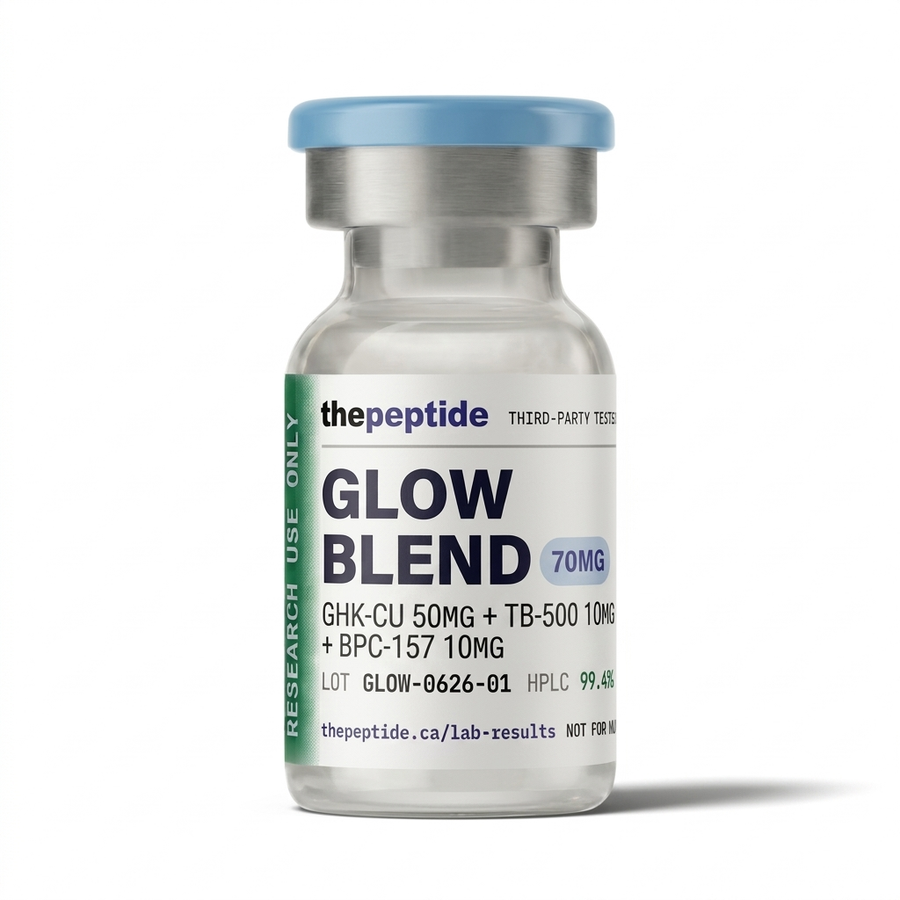
The GLOW Blend combines three of the most heavily studied compounds in skin, connective-tissue and repair research — the copper tripeptide GHK-Cu, the gastric pentadecapeptide BPC-157, and the actin-binding peptide TB-500 (thymosin β4) — co-lyophilised in a single vial for laboratory research use only. The configuration is GHK-Cu 50 mg + BPC-157 10 mg + TB-500 10 mg, 70 mg total, confirmed against this lot's certificate of analysis.
This is a blend, not a single molecule, and that one fact governs everything else on this page. Retatrutide is one 39-residue chain that happens to engage three receptors; GLOW is three chemically unrelated peptides sharing a vial. A blend has no molecular formula, no molecular weight and no single purity number, because those quantities are only defined for one compound at a time. What a responsible blend listing can state is which three peptides are present, how much of each, and how each one is verified. That is the structure of this page, and it is the reason the headline figure here is a per-component certificate rather than a single assay percentage.
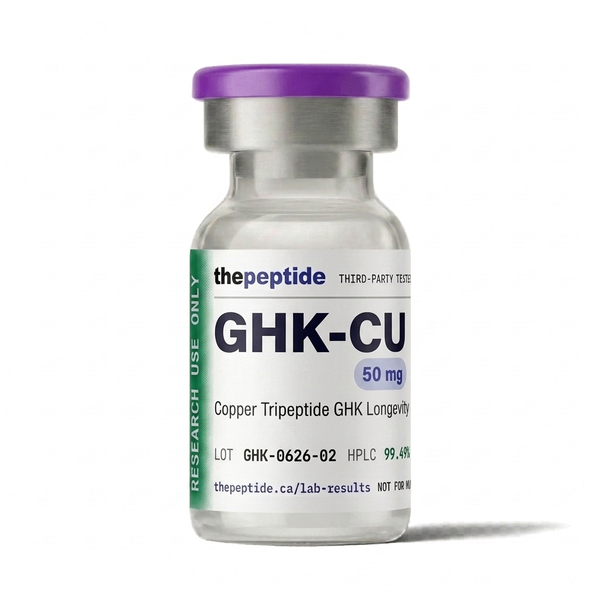
GHK-Cu — the copper-tripeptide arm. GHK-Cu is glycyl-L-histidyl-L-lysine (Gly-His-Lys) complexed with copper(II): molecular formula C14H22CuN6O4, CAS 89030-95-5, molecular weight approximately 403.9 g/mol for the complex (the metal-free tripeptide is C14H24N6O4, 340.4 g/mol, CAS 49557-75-7). GHK was first isolated from human plasma by Pickart and Thaler in 1973 and identified as the tripeptide a few years later. In dermal and wound-model research it is studied for extracellular-matrix remodelling — stimulation of collagen and glycosaminoglycan synthesis in fibroblast cultures (Maquart et al., FEBS Lett 1988;238(2):343-346, PMID 3220688) — alongside antioxidant and copper-transport roles. It is the component that gives GLOW its skin-and-matrix character, and the reason a reconstituted blend takes on a faint blue tint.
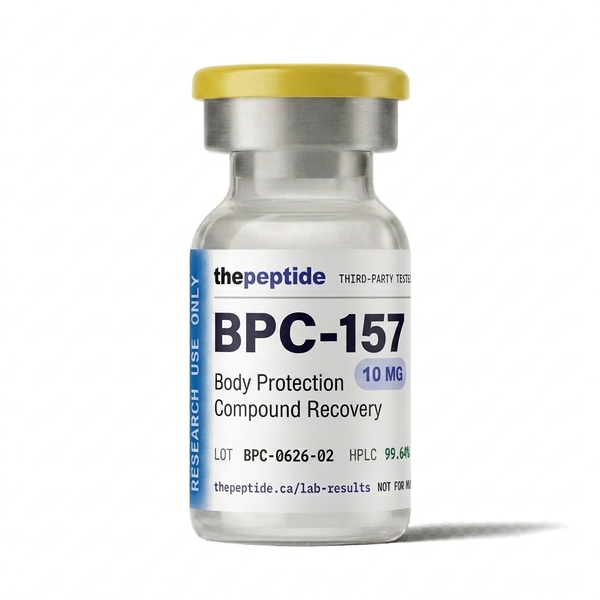
BPC-157 — the soft-tissue arm. BPC-157 is a synthetic 15-residue peptide (Gly-Glu-Pro-Pro-Pro-Gly-Lys-Pro-Ala-Asp-Asp-Ala-Gly-Leu-Val) whose sequence corresponds to a fragment of a "body protection compound" described in gastric juice: molecular formula C62H98N16O22, CAS 137525-51-0, molecular weight approximately 1419.6 g/mol, PubChem CID 9941957. The published research on it is almost entirely in rodents and in vitro, and centres on angiogenic signalling — including VEGFR2 pathway activation (Hsieh et al., J Mol Med 2017;95(3):323-333, PMID 27696202) — and on tendon, ligament and muscle models of fibroblast outgrowth and cell migration (Chang et al., J Appl Physiol 2011;110(3):774-780, PMID 21030672).
TB-500 — the actin/migration arm. "TB-500" is a research-market name tied to thymosin β4 (Tβ4), a 43-residue, ~4.9 kDa G-actin-sequestering protein: full-length formula C212H350N56O78S, CAS 77591-33-4, molecular weight approximately 4963.4 Da. It is studied for actin regulation, endothelial and keratinocyte migration and angiogenesis in repair models (Goldstein et al., Trends Mol Med 2005;11(9):421-429, PMID 16099219; Malinda et al., J Invest Dermatol 1999;113(3):364-368, PMID 10469335). There is a real ambiguity here, addressed in the FAQ: the name "TB-500" historically denotes the short actin-binding fragment Ac-LKKTETQ (~889 Da), but most research-grade material is the full Tβ4 sequence. The published COA states which form this lot contains.
Why these three together. The grouping is studied because the three mechanisms are complementary rather than redundant: GHK-Cu acts on the matrix side (collagen, elastin and glycosaminoglycan signalling, copper delivery, antioxidant pathways), BPC-157 on angiogenic and cytoprotective signalling in connective tissue, and TB-500 on cytoskeletal dynamics and cell migration. A researcher modelling dermal or connective-tissue repair can expose a single system to all three pathways at once instead of reconstituting and co-administering three separate vials, which removes a set of pipetting and lot-matching variables from the experiment. That is the entire rationale: GLOW is a convenience format for parallel-pathway repair research, not a product with any combined effect demonstrated in a clinical trial — no such trial of this three-peptide combination exists.
How a blend is verified. A single peptide is reported as one HPLC area-percent purity number against one identity confirmation. A blend cannot be, because a single percentage across three molecules of different mass and different UV response would be meaningless — it would not tell you whether the 10 mg of BPC-157 is actually present or whether the copper complex has dissociated. Instead, verification confirms the identity and content of each component separately, typically by HPLC with mass-spectrometric identity confirmation, so each of the three peptides is shown to be present and quantified against its labelled mass. This is the same approach we apply to our other multi-component products — the BPC-157 + TB-500 Healing Blend, the Wolverine blend and the CJC-1295 + Ipamorelin blend. The published certificate for this lot reports per-component identity and content, and also records an overall HPLC purity of 99.469%.
The honest evidence and regulatory frame. None of the three components is approved for human use by any regulator, and the blend has no DIN. The published evidence for all three is dominated by in-vitro and rodent work; there are no adequate human efficacy trials for BPC-157 or for the TB-500 fragment, and GHK-Cu's human data is largely topical cosmetic work rather than injectable therapeutic data. Health Canada's public advisory of 9 April 2026 (identification number RA-81874) names GHK-Cu, BPC-157 and TB-500 individually among unauthorised peptides sold online, states that they have not been assessed for safety, efficacy or quality, and states explicitly that labelling a product "For Research Use Only" does not make it legal to sell for human use. Two of the three components are also prohibited in sport: BPC-157 under WADA class S0 and thymosin β4 under class S2. We reproduce these facts rather than bury them.
For laboratory and research use only. Not for human consumption, veterinary use, or therapeutic application. Not approved by Health Canada. No DIN. We do not provide preparation, dilution or administration guidance for any compound we sell.
Shipping is free and tracked, Canada-wide, on every order, with no minimum. Orders are dispatched within 48 hours, Monday to Friday, from British Columbia. Estimated delivery: 2–8 business days.
Sealed, unopened vials are exchangeable within 14 days of delivery. Report damage within 48 hours of the expected delivery date.
The GLOW Blend is a single lyophilised vial containing three separate research peptides: GHK-Cu, a copper-bound tripeptide (glycyl-L-histidyl-L-lysine); BPC-157, a synthetic 15-residue gastric pentadecapeptide; and TB-500, the research-market name tied to thymosin β4, a 43-residue actin-sequestering peptide. The owner-confirmed configuration is GHK-Cu 50 mg + BPC-157 10 mg + TB-500 10 mg, for a total of 70 mg, with the exact per-component mg values confirmed against each lot's certificate of analysis (and flagged pending confirmation on this page until that COA is live).
These three are grouped because they are the standard trio in skin and connective-tissue repair research, and because their studied mechanisms sit on different parts of the same process rather than duplicating one another. GHK-Cu is the copper-tripeptide and extracellular-matrix arm — collagen, elastin and glycosaminoglycan signalling, copper transport and antioxidant pathways. BPC-157 is the angiogenic and cytoprotective arm, studied in tendon, ligament, muscle and gut-barrier models. TB-500 is the cytoskeletal arm, studied for actin regulation, cell migration and angiogenesis. The blend format lets a researcher expose one experimental system to all three pathways at once, rather than reconstituting and co-pipetting three separate vials and introducing three sets of handling and lot-matching variables.
What the blend is not is a product with any demonstrated combined effect. There is no clinical trial of this three-peptide combination, no published pharmacology for the mixture as a mixture, and no approved indication for any of its parts. GLOW is a convenience format for parallel-pathway laboratory research — nothing on this page should be read as a claim that the combination does anything in a human body.
The honest answer is that the three address distinct, non-overlapping steps in tissue-repair models, so running them together lets an investigator look at several pathways in a single system. It is worth being precise about what each one contributes, because "they all help healing" is exactly the kind of flattening this page is built to avoid.
GHK-Cu works on the matrix. In fibroblast culture it has been reported to stimulate collagen synthesis (Maquart et al., FEBS Lett 1988;238(2):343-346, PMID 3220688) and sulphated glycosaminoglycan synthesis, and it delivers copper — a cofactor several matrix enzymes require. It is the component that makes GLOW a dermal and extracellular-matrix reagent rather than only a soft-tissue one.
BPC-157 works on angiogenesis and cytoprotection. Rodent and in-vitro studies associate it with VEGFR2-pathway activation and increased endothelial and fibroblast activity (Hsieh et al., J Mol Med 2017;95(3):323-333, PMID 27696202), and with tendon-cell outgrowth and migration (Chang et al., J Appl Physiol 2011;110(3):774-780, PMID 21030672).
TB-500 works on the cytoskeleton and cell migration. Thymosin β4 sequesters G-actin and has been reported to accelerate wound closure and promote endothelial and keratinocyte migration and angiogenesis (Malinda et al., J Invest Dermatol 1999;113(3):364-368, PMID 10469335; Goldstein et al., Trends Mol Med 2005;11(9):421-429, PMID 16099219).
So the combining rationale is mechanistic complementarity: matrix synthesis, vascular/cytoprotective signalling, and cell migration are three requirements of a repair process, and GLOW puts a reagent for each in one vial. That rationale is a reason to study the combination; it is not evidence that the combination produces an additive or synergistic result, which has not been demonstrated for these three together.
A single peptide is reported with one purity figure — for example "99.6% by HPLC-UV at 214 nm" — which is an area-percent ratio: the target peak's area divided by the total area of everything the detector sees in that one injection. That number is only meaningful when there is exactly one intended compound, so that everything else in the chromatogram is by definition an impurity.
A blend breaks that logic. GLOW contains three intended peptides of very different mass (≈404, ≈1420 and ≈4963 g/mol) and very different UV response, deliberately present at different amounts. A single "purity" percentage across all three would answer no useful question: it could not tell you whether the BPC-157 is actually present at its labelled mass, whether the copper complex has stayed intact, or whether one component has been substituted for a cheaper one. A high combined number could hide a missing component entirely.
So a blend is verified per component. Each of the three peptides is confirmed by identity — typically mass spectrometry, which matches the measured mass to the expected mass of that specific peptide — and by content, a quantitative determination of how much of that component is actually in the vial against its labelled mg. The deliverable is a certificate that lists three identities and three content figures, not one purity percentage. This is exactly how we treat our other multi-component products, the BPC-157 + TB-500 Healing Blend, the Wolverine blend and CJC-1295 + Ipamorelin.
The per-component certificate for this lot (glow70-0626-01) is published, with the lot number and per-component content figures; it also records an overall HPLC purity of 99.469%. When a vendor shows only a single purity percentage on a three-peptide blend with nothing else, that figure is either an aggregate that means little or a number copied from one component and presented as if it covered the others — which is why our certificate reports per-component identity and content, not a bare percentage.
GHK-Cu is the copper(II) complex of the tripeptide glycyl-L-histidyl-L-lysine — molecular formula C14H22CuN6O4, CAS 89030-95-5, molecular weight approximately 403.9 g/mol for the complex (the metal-free peptide GHK is 340.4 g/mol, CAS 49557-75-7). The GHK sequence was first isolated from human plasma by Pickart and Thaler in 1973 and later identified as the tripeptide; it occurs naturally and its plasma level is reported to decline with age.
The research base is genuinely substantial for a peptide of this type, and it is mostly cell-culture and animal work plus topical cosmetic studies. In fibroblast cultures GHK-Cu has been reported to stimulate collagen synthesis (Maquart et al., FEBS Lett 1988;238(2):343-346, PMID 3220688) and sulphated glycosaminoglycan synthesis, and to affect small proteoglycans such as decorin. Review-level work by Pickart and colleagues collates roles in extracellular-matrix remodelling, antioxidant and anti-inflammatory signalling, and copper delivery (Pickart et al., Biomed Res Int 2015;2015:648108, PMID 26236730). A gene-expression review reports that GHK-Cu modulates a large fraction of assayed human genes using Connectivity Map data, with effects on matrix, antioxidant and DNA-repair pathways (Pickart & Margolina, Int J Mol Sci 2018;19(7):1987, PMID 29986520).
Two honest caveats. First, much of the human-relevant data is topical/cosmetic, not injectable-therapeutic data, so it does not transfer automatically to the kind of model a research buyer might build. Second, the broad gene-expression claims come from database-driven analyses and in-vitro systems, not controlled human outcome trials. GHK-Cu is the best-characterised of the three GLOW components in the sense of mechanism breadth, but "well-studied mechanism" is not "proven therapeutic effect," and it is named in Health Canada advisory RA-81874 as an unauthorised peptide. A standalone version is GHK-Cu 50mg.
BPC-157 is a synthetic peptide of 15 amino acids — Gly-Glu-Pro-Pro-Pro-Gly-Lys-Pro-Ala-Asp-Asp-Ala-Gly-Leu-Val — whose sequence corresponds to a fragment of a protein described in gastric juice and nicknamed "body protection compound." Its molecular formula is C62H98N16O22, CAS 137525-51-0, molecular weight approximately 1419.6 g/mol, PubChem CID 9941957. It is often supplied as an acetate salt and is reported to be unusually stable in gastric juice.
The research is almost entirely in vitro and in rodents, and it is reasonably large at that level. The recurring themes are angiogenic signalling — one study links BPC-157's pro-angiogenic activity to VEGFR2 pathway activation and upregulation (Hsieh et al., J Mol Med 2017;95(3):323-333, PMID 27696202) — and connective-tissue repair models, where BPC-157 has been reported to promote tendon-cell outgrowth, survival and migration (Chang et al., J Appl Physiol 2011;110(3):774-780, PMID 21030672) and to upregulate the growth-hormone receptor in tendon fibroblasts (Chang et al., Molecules 2014;19(11):19066-19077, PMID 25415472). Narrative reviews collate these into a soft-tissue-healing hypothesis (Gwyer et al., Cell Tissue Res 2019;377(2):153-159, PMID 31062091).
The caveats are serious and worth stating plainly. Human evidence is minimal: there is no completed, published, adequately powered human efficacy trial; the human record amounts to small retrospective and pilot reports and an unpublished Phase I. Because BPC-157 promotes angiogenesis, there is a theoretical, unresolved concern about promoting unwanted vascularisation, which is a reason it is a research reagent and not a therapeutic. It is named individually in Health Canada advisory RA-81874, and it is prohibited in sport under WADA class S0 (non-approved substances). A standalone version is BPC-157 10mg.
"TB-500" is a research-market name tied to thymosin β4 (Tβ4), a naturally occurring 43-residue, roughly 4.9 kDa peptide and the major G-actin-sequestering protein in many cell types. Full-length Tβ4 has molecular formula C212H350N56O78S, CAS 77591-33-4, molecular weight approximately 4963.4 Da, PubChem CID 16130300. Its core function is binding monomeric actin and regulating the pool available for filament assembly, which places it upstream of cell shape and cell migration.
The repair-research base is well-developed in vitro and in animals. Thymosin β4 has been reported to accelerate wound closure and to promote keratinocyte and endothelial cell migration, collagen deposition and angiogenesis in rodent and cell models (Malinda et al., J Invest Dermatol 1999;113(3):364-368, PMID 10469335), and the mechanistic framing of an actin-sequestering protein "moonlighting" as a tissue-repair factor is set out in Goldstein et al. (Trends Mol Med 2005;11(9):421-429, PMID 16099219). A separate line of work reported cardiac cell migration and survival effects via integrin-linked kinase (Bock-Marquette et al., Nature 2004;432(7016):466-472, PMID 15565145). Notably, the human clinical work that does exist — for example ophthalmic formulations for dry eye and neurotrophic keratopathy — used full-length Tβ4, not the short fragment.
The important caveat for a blend buyer is identity, covered in its own FAQ below: the name "TB-500" historically denotes the short actin-binding fragment Ac-LKKTETQ (≈889 Da, residues 17–23), yet most research-grade "TB-500" is actually the full Tβ4 sequence, and the two are not interchangeable in an assay. Thymosin β4 is also prohibited in sport under WADA class S2, and TB-500 is named in Health Canada advisory RA-81874. A standalone version is TB-500 10mg.
This is the most important FAQ on the page, because the gap between what is studied and what is proven is wide for all three peptides, and wider still for the combination.
No evidence for the combination as a combination. There is no clinical trial, and no published pharmacology, for GHK-Cu + BPC-157 + TB-500 administered together. Any claim of synergy between the three is an inference from three separate literatures, not a measured result. Nothing licenses the idea that the blend does more than its parts.
No adequate human efficacy data for BPC-157 or the TB-500 fragment. The BPC-157 record is dominated by rodent and in-vitro work with only small, mostly unpublished human reports; the injectable TB-500 fragment has essentially no controlled human efficacy trials. The human thymosin-β4 trials that exist used the full-length protein in specific formulations, which does not transfer to a research fragment.
GHK-Cu's strongest human data is topical. Much of the GHK-Cu human evidence is cosmetic skin work, not injectable-therapeutic outcome data, and the broad gene-expression findings come from database analyses and cell systems rather than controlled trials.
No long-term safety data, and a real theoretical concern. Because both BPC-157 and TB-500 promote angiogenesis, there is an unresolved theoretical question about promoting unwanted vascular growth; no long-term safety dataset exists for any of the three as an injectable, and there is no pregnancy, paediatric or organ-impairment data. GHK-Cu additionally delivers copper, and copper balance itself is a variable a careful study must control for.
And none of it is approved. All three components are named in Health Canada's advisory RA-81874; the agency states they have not been assessed for safety, efficacy or quality, that they are illegal to sell for human use in Canada, and that a "Research Use Only" label does not change that. This is a laboratory reagent, and the evidence supports studying it, not using it.
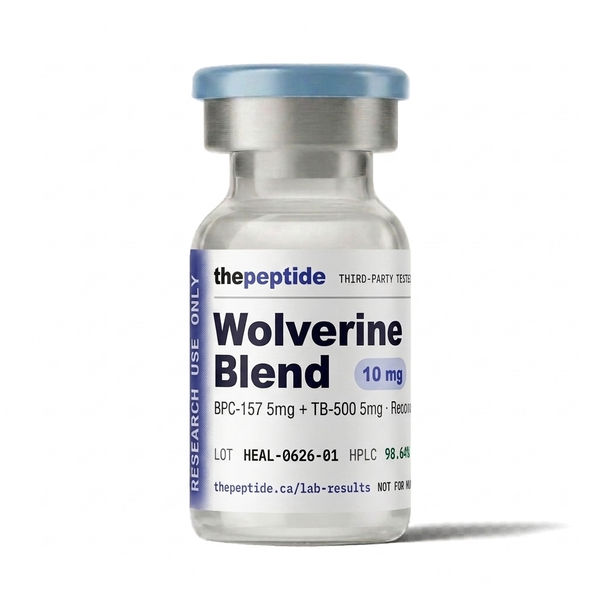
They overlap on two of three components, and the difference is exactly the third. Our Wolverine blend is BPC-157 + TB-500 — the two soft-tissue and angiogenesis peptides — and it is the blend most researchers reach for when the model is tendon, ligament, muscle or gut-barrier repair. GLOW is GHK-Cu + BPC-157 + TB-500: it keeps that soft-tissue pair and adds the copper tripeptide on top.
Adding GHK-Cu changes the character of the reagent. GHK-Cu is the extracellular-matrix and dermal arm — collagen, elastin and glycosaminoglycan synthesis signalling, copper delivery and antioxidant pathways — so GLOW shifts the blend from a predominantly soft-tissue tool toward a skin- and matrix-oriented one. If a model is primarily about dermal fibroblasts, matrix remodelling or copper-dependent processes, the GHK-Cu arm is the reason to choose GLOW over Wolverine. If the model is purely tendon or muscle, the two-component Wolverine (or the equivalent BPC-157 + TB-500 Healing Blend) is the cleaner reagent, because it introduces one fewer variable and no copper into the system.
There is also a practical verification difference. A two-component blend is verified for two identities and two content figures; GLOW is verified for three. More components means more to confirm on the certificate and, in principle, more ways a fill can go wrong, which is one more reason the per-component COA matters. Both blends follow the same rule — identity and content per component, never a single purity number — but GLOW's certificate simply has three lines where Wolverine's has two. Choosing between them is therefore a question about the model, not about which is "stronger": they are not ranked, they are scoped differently.
This is a real and under-discussed ambiguity, and the published COA is where it gets resolved for each lot. The name "TB-500" was originally applied to the short Ac-LKKTETQ peptide — an N-terminally acetylated 7-residue fragment corresponding to residues 17–23 of thymosin β4, molecular weight roughly 889 Da. That fragment contains the central actin-binding motif but lacks the rest of the full protein's surfaces.
In practice, most material sold on the research market as "TB-500" is the full-length thymosin β4 sequence — 43 residues, molecular formula C212H350N56O78S, approximately 4963 Da. The two are chemically different species with a greater-than-fivefold mass difference, and they are not interchangeable in an assay: a mass-spectrometric identity check will immediately distinguish 889 Da from 4963 Da, and a method developed around one will not correctly quantify the other. Any content calculation, any molar normalisation and any comparison to the published Tβ4 literature depends on knowing which form is in the vial.
It matters for interpretation too. The human clinical work on thymosin β4 used the full-length protein; the research-market fragment has essentially no controlled human data of its own. So if a study intends to reference the Tβ4 literature, it needs the full-length form, and the COA has to say so.
Because of all this, we do not assert a form for the GLOW TB-500 component in the abstract. The per-component certificate now published states the measured identity — full-length Tβ4 or the Ac-LKKTETQ fragment — for this lot, with the mass-spectrometric evidence behind it. If your protocol requires one form specifically, confirm it against the certificate before relying on the vial.
It is not an approved product, and all three of its components are named by Health Canada. There is no Health Canada authorisation for GHK-Cu, BPC-157, TB-500 or any blend of them, and no Drug Identification Number. Health Canada's public advisory of 9 April 2026, "Think twice before injecting peptides bought online" (identification number RA-81874), lists GHK-Cu, BPC-157 and TB-500 individually among unauthorised peptides, alongside CJC-1295, DSIP, Epitalon, hCG, ipamorelin, KPV, melanotan I and II, MOTS-c, NAD+ and SS-31.
The advisory makes three points a research-peptide vendor has an obligation to reproduce rather than hide: these products have not been assessed for safety, efficacy or quality; they are illegal to sell for human use in Canada; and labelling a product "For Research Use Only" does not make it legal to sell or use as a drug. The advisory names hormonal, metabolic, liver, kidney, clotting and tumour-growth risks, and the possibility of inconsistent ingredients or contaminants, among its concerns. We sell this vial as a laboratory reagent and not for injection into anyone, for any purpose. A per-component certificate addresses one of Health Canada's concerns — whether the contents are what the label says — and addresses none of the others.
In sport, two of the three components are prohibited. BPC-157 is banned under WADA class S0 (non-approved substances), and thymosin β4 / TB-500 is banned under class S2 (peptide hormones, growth factors and related substances). The GLOW blend therefore contains WADA-prohibited substances and must not be used in or around competition by any athlete subject to anti-doping rules. GHK-Cu is not currently listed as a prohibited substance, but its presence does not offset the other two. Monitoring or non-listing of one component is never permission for the blend.
Each GLOW lot carries a per-component certificate of analysis; the certificate for lot glow70-0626-01 is now published. For each of the three peptides the certificate reports two distinct measurements. The first is identity: mass spectrometry matches the measured mass of each species to the expected mass of that specific peptide — approximately 404 Da for the GHK-Cu complex region, approximately 1420 Da for BPC-157, and either approximately 4963 Da (full-length thymosin β4) or approximately 889 Da (the Ac-LKKTETQ fragment) for the TB-500 component. The second is content: a quantitative determination of how many milligrams of each component are actually present, reported against the labelled per-component mass.
That is deliberately different from a single-peptide certificate, which reports one HPLC area-percent purity figure. For a three-peptide mixture a single purity number is not just unhelpful, it is misleading — it cannot reveal a missing or under-filled component, and a flattering aggregate can hide exactly the failure a buyer most needs to catch. So GLOW's certificate shows three identities and three content figures, and for this lot it also records an overall HPLC purity of 99.469%.
This lot's certificate is published: lot glow70-0626-01 records an overall HPLC purity of 99.469% alongside the per-component identity and content results. We do not publish numbers we cannot stand behind with a document. This follows the same discipline as the rest of our catalogue, where a certified lot carries a named laboratory and a verifiable report number and an uncertified one says so plainly. The GLOW COA is indexed on our lab results page with the rest of the catalogue, and the methodology walkthrough in how to read a peptide COA explains how to read a per-component certificate.
Lyophilised, sealed and desiccated: −20 °C for long-term holding, 2–8 °C for short-term, protected from light. That is the research convention for unformulated peptides and it is what the specification table states. Sealed vials tolerate ambient shipping temperatures for the transit period without meaningful loss; the cold requirement applies to holding, not to the journey.
A blend adds one consideration a single peptide does not have: the three components have different stability profiles, so the storage regime has to be conservative enough for the most fragile of them. The copper complex in GHK-Cu can in principle dissociate or participate in copper-catalysed oxidation, and thymosin β4 is a large, flexible peptide with its own susceptibilities, so there is no "store to the most robust component" shortcut — the cold, dark, dry default protects all three.
After reconstitution with sterile or bacteriostatic water, hold at 2–8 °C and minimise freeze–thaw cycling, which is the most common avoidable cause of peptide loss. Divide a reconstituted stock into single-use aliquots at first preparation so no working volume is thawed twice, and do not return thawed material to the freezer. Avoid vigorous agitation, which can drive adsorption and aggregation at air–liquid interfaces — a realistic loss pathway for peptides of this size.
We publish no figure for how long the reconstituted blend remains intact, because no stability study we can verify has been published for this three-peptide mixture in solution at any concentration, buffer or temperature — and because the three components would not necessarily degrade on the same timeline, a single "good for N days" claim for the blend would be a guess. Suppliers quoting a specific number of days for a blend are quoting something they have not measured. We stock bacteriostatic water 3ml for laboratory reconstitution.
Shipping is free and tracked, Canada-wide, on every order, with no minimum. Orders are dispatched within 48 hours, Monday to Friday, from our facility in British Columbia. Because the vial is already in Canada there is no international leg, no customs clearance and no brokerage fee on a domestic order, and no risk of a shipment being held or seized at a border — the single most common failure point for peptides bought from overseas vendors.
Because the GLOW blend is a coming-soon listing, orders placed before launch ship once the lot is released with its per-component certificate of analysis; we do not dispatch a blend vial before its COA exists, because the whole point of a per-component certificate is that it accompanies the vial it describes. Once the product is live, vials leave sealed and tracking is issued at dispatch, so the shipment can be followed from our facility to delivery.
One cosmetic note specific to this blend: GHK-Cu gives the lyophilised powder and the reconstituted solution a characteristic pale-blue tint, which is expected from the copper complex and is not a sign of degradation, contamination or a problem with the vial. A colourless GLOW vial would be more surprising than a blue one. Sealed vials tolerate ambient shipping temperatures for the transit period without meaningful loss; the cold-storage requirement applies to holding the material once it arrives, not to the journey itself. Current transit estimates by province are on our shipping page, and tracking questions can go to info@thepeptide.ca.
Report damage in transit or non-delivery to info@thepeptide.ca within 48 hours of the expected delivery date, with photographs of the packaging and the vial where applicable, and we will resolve it — a replacement or a refund, as the situation warrants. A cracked, leaking or visibly compromised vial should be reported before anything is opened, so the state it arrived in can be documented.
Sealed, unopened vials are exchangeable within 14 days of delivery. There are no refunds or exchanges on product that has been opened, reconstituted or otherwise prepared: once a seal is broken we cannot verify the handling history, and a reagent of unknown temperature and light exposure is not one we will put back into circulation for another researcher.
This distinction matters more for a blend than for a single peptide. A single peptide vial that is returned unopened can in principle be re-checked against its own certificate; an opened GLOW vial cannot be re-qualified at all, because the three components do not share a degradation profile and there is no single purity measurement that would confirm all three survived whatever handling occurred. Verifying a used multi-peptide vial would mean re-running a full per-component identity-and-content panel on material of unknown provenance, which is neither practical nor a basis on which we would resell. For that reason the sealed-only rule is firm for this product. The pale-blue colour of the GLOW powder, incidentally, is not a defect and is not grounds for return — it is the expected appearance of the GHK-Cu copper complex. Full terms are on our refund policy page.